Showing posts with label ganymede. Show all posts

Saturday, April 28, 2007

"Jupiter Five" (short story): Precursor to "Rendezvous with Rama"

This story obviously leads better known "Rendezvous with Rama" - there are just too many similarities. This story also has elements that will be seen in the 3 sequels of "2001 A Space Odyssey".

Story summary (spoiler).
Like Rendezvous, we have an alien spaceship in our solar system with kilometer scale dimensions. Like Rama, this is a complete independent habitat including its own sea. Like Rama, it has traveled for untold number of years through interstellar space. Like Rama, number 3 is important to these aliens - e.g., the ship's hull comprises of 3 layers.

Unlike Rama, this ship is spherical rather than cylindrical in shape, & has multiple entrances rather than only one. Also unlike Rama, it is dead & has been dead for several million years.

And, for a change, the aliens are not tentacled but reptilians, as in "History Lesson".

But by & large, the story is in the same style & tone as Rendezvous.

Last third is just a mundane fight of wits, & could have been dropped from story without any effect; it just prolongs the story. Or may be it is a precursor to 3 Rendezvous sequels; there are similarities with those sequels.

You get a preview of Odyssey sequels in the form of voyage to Jupiter, & a stopover at Ganymede.

Quite a readable story, but I prefer Rendezvous.

Fact sheet.
Jupiter Five, short story, review
Author: Arthur C Clarke
Genre: Science fiction
First Published: 1953
Rating: B

Series: "Jupiter Five" (A), "Rendezvous with Rama" (A), "Rama II" (C) , "Garden of Rama" (B), "Rama Revealed" (B)

The story appears in the following collections.

  1. "Reach for tomorrow"
  2. "The Collected Stories of Arthur C Clarke"
  3. "Across the Sea of Stars"
  4. "The Sentinel (collection)"

Saturday, April 21, 2007

"3001 The Final Odyssey" (novel): Somewhat anticlimactic

Quote from the novel 3001 The Final Odyssey by Arthur C ClarkeThis book is almost entirely fantasy rather than science fiction. Except a few pages of rather reasonable philosophical discourse about mid-way through the book, & that too is borrowed from similar discourse in "The City & the Stars". And in spite of the finality of the title, the end of the story leaves a lot of scope for further sequels.

Also, this book liberally copies whole passages from previous books in the series.

Story summary (spoiler).
First one third of the book is a kind of time warp: imagine you moved 1000 years ahead in time; how would you react to human society of this future. There have been perhaps a half dozen movies on the subject - both in Bombay, & in Hollywood. But Clarke is creative. Cannot fault him for borrowing from these movies.

Among the many devices described here, you find a mention of space ships that use "anti-gravity", a technology that first appears in "Rescue Party" - the mother of all Clarke stories.

Middle one third is generally slow paced: a voyage from earth to Ganymede, & a little excursion from Ganymede to Europa. Sole interesting part of the book is in the middle of this section - a short philosophical discourse on human nature; I copy some quotes below.

Note that a similar voyage to Ganymede, & then to another moon in Jupiter system, also happens in "Jupiter Five" - the story that will ultimately become "The Songs of Distant Earth".

Last third is about as fantastic as the last story in 2001. Unimaginably powerful gods are humbled by humans!

Last third also partially explains the discrepancy in the series so far: around 22,000 AD, Europans are at about the level of stone age humans in development, & Lucifer is shining. But in 3000 AD, Lucifer has stopped shining! We are now told this "stopped shining" was a temporary phenomenon that lasted only a few hours - as humans outwitted gods.

There is still a discrepancy remaining in the series. If humans outwitted gods in 3000 AD, how come Europans are still happy & safe from humans on Europa in 20,000 AD; and still protected by TMA in Europa that vanished when humans attacked gods in 3000 AD! But as Clarke explains towards the end of this book - it is fiction written over three decades. Don't bother with discrepancies. Enjoy the stories, instead of doing nit picking.

Quotations.
Quotes below are all taken from a little philosophical discussion near the middle of this book.

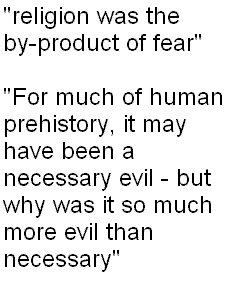
  • "religion was the by-product of fear - a reaction to a mysterious and often hostile universe. For much of human prehistory, it may have been a necessary evil - but why was it so much more evil than necessary". "I said evil - and I mean it, because fear leads to cruelty".
  • "obvious madmen, century after century, will proclaim that they - and they alone! - had received messages from God. If all the messages had agreed, they would have settled the matter. But of course they were wildly discordant - which never prevented self-styled messiahs from gathering hundreds - sometimes millions - of adherents".
  • "most of the humanity has always been insane, at least some of the time".
  • "There's never been anything, however absurd, that countless people weren't prepared to believe, often so passionately that they'd fight to the death rather than abandon their illusions. To me, that's a good operational definition of insanity."
  • "Do you believe in ghosts, Dim?" "Certainly not: but like every sensible man, I'm afraid of them."
Fact sheet.
3001 The Final Odyssey, novel, review
Author: Arthur C Clarke
Genre: Fantasy
First published: 1997
Rating: B

See also:
  1. "Space Odyssey series summary"
  2. "Influences" section of "Rescue Party"
  3. The ring habitat connected to earth with many spokes around equator that are space elevators that we see in first one third of this story also appears at the end of "The Fountains of Paradise". But there, we see it in about 4000 AD, & without details of its interior.
  4. "The City & the Stars", a much earlier novel, has a religious discourse about its middle that is essentially the same as that in the middle of this book.
  5. "Imperial Earth" is another Clarkian story that describes human life about the year 3000 AD. I personally find Imperial Earth's descriptions far more realistic.

Thursday, April 19, 2007

"2061 Odyssey Three" (novel): Good thriller

This is the second of 3 sequels to "2001 A Space Odyssey".

While this shipwreck & rescue thriller pretty much gives away suspense at the very beginning (if you have read 2010), it is still generally a good read.

Also, this is generally a better book compared to first sequel - 2010. Fewer ghosts, no gods, few descriptions of wonderful alien creatures; and they don't last long. This is mostly a human story. There are some pages copied verbatim from 2010, but they are easy to ignore.

This book differs from earlier two in another respect also. It is a single story, rather than 4 different stories strung together.

While all the action happens in space, there are three parties on earth that play a role - but in background.

  • A Chinese (or is he from Hong Kong? I forget) business tycoon (good guy). He runs an interplanetary shuttle service; two of his ships are involved in most of action.
  • South African mafia (bad guys).
  • A brilliant physicist (or is it chemist?). I forget his name.
There are two main theaters of action - Halley's Comet, & Europa (a moon of Jupiter-that has-become-a-sun named Lucifer). There is also some subsidiary action on Ganymede, another Jupiter moon. And preliminaries on earth.

Story summary (spoiler).
Action begins when the book is about a quarter through - a pleasure cum research voyage to Halley's Comet that is currently passing through inner solar system. A lot of pages on landing there, local scenery, features, etc.

Something has been cooking on Ganymede. Someone has seen a new feature on Europa with interesting characteristics. And wants to verify. Permission is quickly obtained from powers-that-matter on earth to throw a geological probe.

Since Europa is off bounds to humanity, according to Gods' dictate in previous book, a somewhat elaborate hoax is prepared for this voyage. After some adventures, there is a hijacking & an accident, & our friends land on Europa. Miraculously, powers protecting Europa don't mind.

Rest is the story of their rescue by the other ship at Halley's, & the wonderful sights the shipwrecked see on Europa.

End is ominous, with ample scope for next sequel.
  • Lucifer dies. What will now happen to the newly lit worlds made possible by converting Jupiter into a sun?
  • A new monster (TMA-4?) is introduced in New York City. And death of Lucifer has woken it up.
  • A new ghost is created, without the man dying, by the two ghosts of previous book. As a kind of simulation. So we now have 3 ghosts to contend with - in next book.
Good luck.

PS: Sounds like is a discrepancy here. 2010 says there are Europans at the level of development of human cavemen in 22,000 AD. At that time, Lucifer is still shining. How come it burned out in this book? I wonder if I missed something out.

Fact sheet.
2061 Odyssey Three, novel, review
Author: Arthur C Clarke
Genre: Science fiction
First published: 1987
Rating: B
See also: "Space Odyssey series summary", "Influences" section of "Rescue Party"