Showing posts with label space elevator. Show all posts

Sunday, May 6, 2007

"The Fountains of Paradise" (novel): Extraordinary plot, ruined

Essential idea behind the novel titled The Fountains of Paradise by Arthur ClarkeThis could have been among the best science fiction stories by anyone, but Clarke just keeps going on tangents rather than sticking to the main story. I felt a bit sad at the end; what a waste!

This also is among the most down to earth stories of Clarke, in company with "The Deep Range". Except for various diversions. Also, these two stories share a tenuous link via Thero, a kind of Dalai Lama of a fictional Buddhist sect based in Lanka; this was first introduced in Deep Range, & also gets substantial coverage in Fountains.

Story summary (spoiler).
Main story is about a concept called "space elevator". Depending on your perspective, it can be seen as an ordinary elevator of extraordinary size (some 40,000 km high), a space vehicle, or a subway.

Idea is to outdate the rockets that take off from earth, & make space travel affordable for ordinary people.

In a massive construction project, a space station will be connected to earth via a physical tower - a kind of very thick cable. All spacecraft will leave off the space station rather than earth - means much cheaper & environment friendly takeoff. You can buy a ticket for joy ride up the elevator, or for actual travel to moon, mars, or elsewhere.

It is the story of an entrepreneur civil engineer. Beginning with the concept, to getting funding, overcoming political opposition, handling displaced people, apart from the various technical aspects. Though handling displaced people has been treated as a joke here. I guess Mukesh Ambani might have done a more convincing job presenting this story, but Clarke does a good enough job - so long as he sticks to the main story. Main story is set sometime between 2100 AD & 2200 AD.

This main story is interwoven with several completely unrelated tangents: the story of a feudal empire in Lanka around 100 AD; story of an alien robotic spacecraft moving through our solar system aka "Rendezvous with Rama"; story of the Sun cooling down to turn earth into an icy wasteland aka first story in "History Lesson"; story of visit to earth of aliens that look like a more physical version of the Swarm in "The Possessed"; a rather juvenile story of our heroic boss of the whole enterprise rescuing some stranded explorers up in the tower during an accident. There might be more, but I can recollect these off hand.

It took me nearly 3 weeks to cover first 20% - story begins on one of the tangents. Around 20% mark, real story begins & for a while you cannot put the book down.

Then the alien robotic spacecraft visits. It is both similar to Rama & different. For one thing, it is very talkative - likes to converse with humans. It is cylindrical, but main craft has dimensions only in meters rather than kilometers. But it has a 500 km diameter antenna for communicating with its home world!

Then again the main story continues well for a while, amid reports of changes happening to the Sun.

Rescue drama begins when you are may be 60 or 70% through the book, & occupies most of the remaining pages. It is not only juvenile, but very filmy - everything that can go wrong does but one at a time, keeping you reading far longer than necessary.

Last 5% is set in about 4000 AD. We meet an alien who is a more physical version of the Swarm of "The Possessed". This is also where we have not only the original space elevator in working condition, but many more across earth, all linked together in space - forming a ring habitat; interior of this habitat will be detailed in the first one third of "3001 The Final Odyssey". You also see earth that is essentially uninhabited because it has now turned into an icy wasteland aka first story in "History Lesson"; humans live in ring habitat up in the sky, & also on Venus & Mercury which are now both habitable.

This is not a book worth skipping. But I had to skip a lot of pages on first reading; then came back to go through the fillers.

Putting the height of space elevator in perspective.
It is easy to read numbers like 36 or 40 thousand kilometers tall. Yes, it sounds tall - but how tall?

This is about the size of the perimeter of earth. Or about 3 times the diameter of earth!

This is also 7% the distance to moon. 15 such structures, & you can drive to moon!

An ordinary commercial jetliner will make you sit for over 40 hours to travel this distance.

How realistic is the concept of space elevators?
There are actually a lot of documents on the subject. I include only a few "not boring" articles meant for general public.

  1. "Space elevators"
  2. LiftPort's space elevator projects' discussion at Slashdot.
Fact sheet.
The Fountains of Paradise, novel, review
Author: Arthur C Clarke
Genre: Science fiction, with a sprinkling of fantasy & ancient feudal history
First published: 1979
Rating: A
Hugo Award winner in novel category in 1980

See also.
  1. This article includes illustrations of space elevator anchors at earth end & sky end (near the bottom of the article).
  2. "The Ghost from the Grand Banks" also has an unrelated small subplot at the end where aliens investigate a now barren earth.
  3. All Hugo Award stories.

Saturday, April 21, 2007

"3001 The Final Odyssey" (novel): Somewhat anticlimactic

Quote from the novel 3001 The Final Odyssey by Arthur C ClarkeThis book is almost entirely fantasy rather than science fiction. Except a few pages of rather reasonable philosophical discourse about mid-way through the book, & that too is borrowed from similar discourse in "The City & the Stars". And in spite of the finality of the title, the end of the story leaves a lot of scope for further sequels.

Also, this book liberally copies whole passages from previous books in the series.

Story summary (spoiler).
First one third of the book is a kind of time warp: imagine you moved 1000 years ahead in time; how would you react to human society of this future. There have been perhaps a half dozen movies on the subject - both in Bombay, & in Hollywood. But Clarke is creative. Cannot fault him for borrowing from these movies.

Among the many devices described here, you find a mention of space ships that use "anti-gravity", a technology that first appears in "Rescue Party" - the mother of all Clarke stories.

Middle one third is generally slow paced: a voyage from earth to Ganymede, & a little excursion from Ganymede to Europa. Sole interesting part of the book is in the middle of this section - a short philosophical discourse on human nature; I copy some quotes below.

Note that a similar voyage to Ganymede, & then to another moon in Jupiter system, also happens in "Jupiter Five" - the story that will ultimately become "The Songs of Distant Earth".

Last third is about as fantastic as the last story in 2001. Unimaginably powerful gods are humbled by humans!

Last third also partially explains the discrepancy in the series so far: around 22,000 AD, Europans are at about the level of stone age humans in development, & Lucifer is shining. But in 3000 AD, Lucifer has stopped shining! We are now told this "stopped shining" was a temporary phenomenon that lasted only a few hours - as humans outwitted gods.

There is still a discrepancy remaining in the series. If humans outwitted gods in 3000 AD, how come Europans are still happy & safe from humans on Europa in 20,000 AD; and still protected by TMA in Europa that vanished when humans attacked gods in 3000 AD! But as Clarke explains towards the end of this book - it is fiction written over three decades. Don't bother with discrepancies. Enjoy the stories, instead of doing nit picking.

Quotations.
Quotes below are all taken from a little philosophical discussion near the middle of this book.

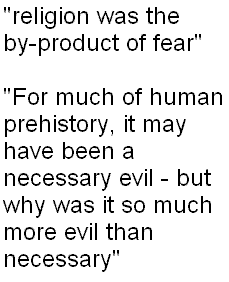
  • "religion was the by-product of fear - a reaction to a mysterious and often hostile universe. For much of human prehistory, it may have been a necessary evil - but why was it so much more evil than necessary". "I said evil - and I mean it, because fear leads to cruelty".
  • "obvious madmen, century after century, will proclaim that they - and they alone! - had received messages from God. If all the messages had agreed, they would have settled the matter. But of course they were wildly discordant - which never prevented self-styled messiahs from gathering hundreds - sometimes millions - of adherents".
  • "most of the humanity has always been insane, at least some of the time".
  • "There's never been anything, however absurd, that countless people weren't prepared to believe, often so passionately that they'd fight to the death rather than abandon their illusions. To me, that's a good operational definition of insanity."
  • "Do you believe in ghosts, Dim?" "Certainly not: but like every sensible man, I'm afraid of them."
Fact sheet.
3001 The Final Odyssey, novel, review
Author: Arthur C Clarke
Genre: Fantasy
First published: 1997
Rating: B

See also:
  1. "Space Odyssey series summary"
  2. "Influences" section of "Rescue Party"
  3. The ring habitat connected to earth with many spokes around equator that are space elevators that we see in first one third of this story also appears at the end of "The Fountains of Paradise". But there, we see it in about 4000 AD, & without details of its interior.
  4. "The City & the Stars", a much earlier novel, has a religious discourse about its middle that is essentially the same as that in the middle of this book.
  5. "Imperial Earth" is another Clarkian story that describes human life about the year 3000 AD. I personally find Imperial Earth's descriptions far more realistic.

Sunday, March 25, 2007

"The Songs of Distant Earth" (novel): Unputdownable!

Review of the novel titled The Songs of Distant Earth by Arthur ClarkeWhile this 20 year old book is not among my all time top five science fiction novels, it must come among those immediately after them. Fast paced, very readable, & one of the most optimistic treatments of doomsday in fiction. And some very interesting ideas for the technical minded.

Note that this story is essentially an expanded & better developed form of "Rescue Party" - mother of all Clarke fiction.

Story summary (spoiler).
Main story is about the visit (to pick up supplies) to a small isolated community by a group of visitors on their way to a far off place. In a very exotic background & locale, 1500 years in future.

Story has a cooked up doomsday background: there is laboratory evidence that Sun is about to die by exploding - means the end of solar system, including earth. And you don't have warp drive or space drive or similar contraptions of Star Trek ilk. Any action is to be based on nearly current level of human knowledge. You are given a few hundred years to prepare for it.

This background description actually occupies very few pages, & in flashback. Action occurs on a little watery world (remember Hollywood movie Waterworld?) 50 light years from earth.

There are a few sad & nostalgic pages, but mostly a very optimistic drama about the best that makes us human.

An energy source.
Among a variety of cool devices described, there is one I had never heard of before. After some checking in physics literature, I know I am not the only optimist (yeah - I know wishful thinking!) that some day our energy problems might be solved by an unconventional source with a rather exotic name - "zero-point energy".

It is a physical phenomenon first described in 1913 by Albert Einstein & Otto Stern: every volume of space, including interstellar vacuum, is bubbling with an "absurdly huge" amount of energy visible only at a microscopic level.

A bit of googling threw it up as one of the biggest hurdles in today's nanotechnology - small structures are exposed to so much energy they keep getting twisted & torn! There are hints on web of credible projects currently on based on the hope we can tap this energy.

Trivia.
This novel is an expansion of a 3 decade older short story of the same name, according to Clarke's introduction to shorter version in "The Collected Stories of Arthur C Clarke". Short was first published in "If", Jun 1958. I haven't read the shorter version yet.

Fact sheet.
The Songs of Distant Earth, novel, review
Author: Arthur C Clarke
Genre: Science fiction
First published: 1986
Rating: A

Series: "Rescue Party" (A), "The Songs of Distant Earth" (A)

See also.

  1. Songs carries unmistakable influence of Clarke's short story "The Star" published 3 decades earlier. Both share the same doomsday scenario.
  2. Plot of this novel, & also of "The Star", is very similar to that of "Rescue Party" - first story ever published by Clarke.
  3. "Improving the Neighborhood" also has zero-point energy, but it makes earth & moon explode in an accident!
  4. Alastair Reynolds' "Turquoise Days" appears to have borrowed a plot element from Songs.
The novel is also included in the following collections.
  1. "The Sentinel (collection)" (unless there is another short story version with the same title!)
  2. "More Than One Universe" (unless there is another short story version with the same title!)