Showing posts with label moon. Show all posts

Wednesday, June 6, 2007

"Islands in the Sky" (novel): Description of futuristic space stations

Review of the novel titled Islands in the Sky by Arthur ClarkeVery readable space adventure, but with a somewhat filmy presentation.

Story summary (spoiler).

This story is set in the mid twenty first century (or is it late twenty first - I forget). Told mostly in first person, it describes the adventures of a young man in near earth space & on a trip around moon - over a period spanning a few weeks.

Main protagonist, Roy Malcolm, wins an all-expenses-paid trip to "Inner Station" by winning a television quiz. This Inner Station is a space station about 500 km above earth, & is a kind of fueling & maintenance depot for space ships. Travel between earth & Station is via rocket powered machines that are somewhat advanced versions of NASA's current space shuttles.

This space station, & others described, don't look like the kind we normally read about. But the claim is they are realistic, if futuristic.

About half the story is a description of this station, & life aboard it. There are far more human interest elements here than in "Rendezvous with Rama" - another novel that is chiefly the description of a machine. Among the many generally interesting events & devices is the shooting of a movie in space that occupies not insubstantial part of this first half.

An interesting device described is a solar electric generator that doesn't use photo-voltaic elements, but a curved mirror to focus heat at a point - to heat water that will then be converted to electricity via a steam based generator! The mirror reminded me of the lens I sometimes used as a child to concentrate solar heat to make burn marks on dry twigs.

Much of later half of the story is adventure travel to other space stations & around moon in circumstances that are often very filmy. We are given a tour of a space station that is a hospital & a biology research center, much above the orbit of Inner Station. We are also shown how tiny earth creatures can grow to huge sizes in zero gravity conditions.

Next is an accidental trip around moon as part of a journey from hospital station to Inner Station! Here we are introduced to a new kind of space launch device: a kind of magnetic rail - several km long, with one end open, on the surface of the moon. To launch a payload, you accelerate it to moon-escape velocity & let it fall off open end! Because moon has much more curvature than earth, if enough velocity is given, the payload goes to space! No rockets!

We then go to one of the three Relay Stations in geosynchronous orbit - the kind of radio communication relays Clarke is often credited with first describing. Only they don't look anything like communications satellites we are familiar with. Also, in the scheme here, only 3 huge devices (and manned space stations at that) live in this orbit, 120 degrees apart - giving coverage over entire earth's surface. Presumably, some kind of UN agency must be running them, though it is not mentioned.

A few days after return to Inner Station, our friend must leave for earth via a space hotel - a machine very similar in concept to Rama, along with a swimming pool that is essentially a smaller version of Rama's cylindrical sea.

We are told Mars, Venus & Moon are now inhabited. This hotel, located in orbit of Inner Station a few kilometers away, provides three levels of Rama-style gravity - earth level, two thirds of it, & one third of it. This is used by travelers from smaller worlds to adjust to earth's higher gravity. Our friend will have to readjust as well, because he has spent some weeks in zero gravity.

In between, there are two stories told by people other than Roy.

One is a manned trip to Mercury's "night side". I am not sure the latest data supports the assumption that Mercury always shows same face to Sun, but this is an old story. We also meet an animal native to Mercury here!

Other story is of Martian colony. Chief highlight of this story is to tell us that current novel is kind of a sequel to "The Sands of Mars" - the story assumes background set by Sands.

One thing that was very obvious from this story, & also some other space travel stories of Clarke as also the Wikipedia article on NASA space shuttles, is something very familiar to every Mumbaikar: humans tend to litter when they are not being watched.

There are probably a lot of meteorites floating in earth orbit & in space that are man made, as also some of the stuff falling from the sky. You don't need something anymore? Just jettison. With luck, nobody will get hurt. At least not often enough for substantial court settlements! I am getting sympathetic with environmentalists!

Fact sheet.

"Islands in the Sky", novel, review
Author: Arthur C Clarke
First published: 1952
Genre: Science Fiction
Rating: A

See also.

  1. "Rendezvous with Rama" (novel): Both stories are essentially about the description of a machine. Also, the space hotel near Inner Station is very similar in design to Rama, though of much smaller size.
  2. "The Sands of Mars" (novel): There is a hint Islands is a kind of sequel to Sands.
  3. Robert Heinlein's short story "Misfit" (1939) is about construction of space station, but at a scale much grander than Islands. And Heinlein's station won't orbit earth, but sun - between the orbits of earth & Mars - to support interplanetary traffic.
  4. "Maelstrom II" (short story): Shares a small plot element with this story - space launches on moon via electromagnetic rail based catapults.

Tuesday, May 29, 2007

"Richter 10" (novel): Taming the earthquakes

Review of the novel titled Richter 10 by Arthur Clarke & (Late) Mike McQuayFirst half of this book is outstanding; next quarter is good; last quarter is positively lousy, & completely unrelated to rest of the story.
The most irritating thing I find in all Clarkian novels - the tendency to spend a lot of time on threads totally unrelated to main story - is here in full glory. In spite of this, I have no hesitation in calling the first half the best among all Clarkian novels I have reviewed to date (current one is #17).

This story is actually not written by Clarke. It was written by late Mike McQuay to outline provided by Clarke - in a manner similar to Rama sequels.

Story summary (spoiler).

The story spans the lifetime of the main protagonist, Lewis Crane, beginning late 20th century.

There are three memorable scenes in the story, all in first half: a little boy rendered a cripple & an orphan by an earthquake in US; a callous administration letting an entire village die unnecessarily in Japan; & unscrupulous politicians & businessmen letting thousands die unnecessarily in big quake in US. Each of these scenes borders on horror, & yet there is a lot of optimism.

First scene introduces the hero, Lewis Crane. In a milder, but still very moving, variant of similar opener in Jean Auel's "The Clan of Cave Bear", the little boy loses use one arm, his parents, & his house in an earthquake in California.

Next we encounter Crane as an adult, world's foremost expert on earthquakes, a Nobel laureate, a top grade entrepreneur, & founder of the Foundation - his research organization. And now finally ready with his first big earthquake prediction months in advance - at a Japanese island called Sodo. The quake will destroy most of the island, & one entire inhabited village called Aikawa.

Only trouble is: no one believes Crane. Villagers & local government are unhappy because this prediction has ruined tourist traffic. Crane has collected world media for the event at a small spot on the island that will survive, & but a lot of media is covering the event from air.

And here we get the second big scene. Mayor arrives with cops to arrest Crane & deport him because they see him as scaremonger. That is when the quake hits. Everything is to prediction. When the dust settles, the village is a beach.

Crane is now a celebrity & harbinger of the evil. That is when he decides to raise funds for his bigger & super secret project: banish quakes by stopping all tectonic activity - by fusing together the plates comprising earth's crust at strategic places, about 50 locations in all. Using atomic bombs in a way that will direct their power towards earth's core, without any damage to surface.

Next major scene is a big quake prediction in some parts of the US bordering Mississippi river; in between, we have seen Crane directing rescue at a volcano (Pelee) affected island (Martinique) in the Mediterranean - but that was a minor thread. Only problem is: elections are soon due, & someone has figured a way to benefit from the quake. In a bizarre twist, field data of Foundation is intercepted & forged by the villain. Result is: Crane prediction is too soon by a few months. Crane loses credibility.

When Crane figures out the reason, & the fact that quack is still coming, there is a problem in communication - he needs to get credibility. Enter Harry Whetstone, his billionaire benefactor & friend. He convinces Harry to bet most of his $3b wealth on his prediction. And our friends go public with a wager: at 2:1 odds, our friends offer wagers of $50 each that quake will happen on new date. Wager is quickly lapped up.

Come D-day. Government is publicly denying any quake possibility. Public is against our friends, though there are sympathizers. In a relief camp set up at a safe location near to-be-worst-affected areas, Crane & his benefactor are arrested.

Of course, the quake hits as predicted. Our friends are on the scene directing relief. Crane emerges larger than life after the event. He has returned the $3b borrowed from friend, & now has enough money for his Foundation from the won wager that he no longer need depend on any external sources.

To kickstart his big project - the fusing of tectonic plates, Crane has some help from earth. About 20 years down, there will be a quake that will split much of California from rest of US, & make it a Pacific island. With widespread loss of life & property. And this event can be avoided - by putting the first "spot weld" joint somewhere in western US that will also substantially cut down the number of quakes worldwide.

He enlists political support, sets up a secure facility on the lines of US bomb making project in 1940s.

Rest of the story, about a quarter of the book, is bizarre - to say the least. And second rate, at least to me. And links with many tangent threads that have already been introduced into the story.

Falling apart of Crane with his main technical man Dan; Dan joining a muslim fundamentalist organization; terrorist attack on the secure facility that destroys the facility & kills Crane's wife & child; formation of an Islamic state within US. And introduction of more tangent threads - creation of a colony on moon, & their mining of water from permafrost on Mars rather than from Earth!

Among the other tangent threads in the story are: Middle East as a radioactive wasteland, a radioactive cloud that has been moving around earth for decades, ozone layer gone, Europe & US as Third World, & the world dominated by Africa & China. At one stage, we are told the world is 70% muslim, & US is mostly black & hispanic! These threads spread all through the book.

There is a stage where some sanity could have been introduced into the plot. Dan's key technical objection to Crane's fusion project are probably sound: there would not have been any life on earth if earth could not renew itself with tectonic activity; how do you know you are not banishing future life from earth? But this angle is never developed & quickly abandoned.

The book describes a lot of tech toys - brain implants, mood enhancing drugs, wrist-worn computers, projector-based televisions that normally use clouds & outside of public buildings as display surfaces, aural implants, flying cars, ... I wonder why just quake taming was not enough sf!

End of the book is the big quake in California. Crane & Dan have made peace, & will be committing suicide in the quake together!

Key characters.

  1. Lewis Crane: Hero - the man who will banish the earthquakes.
  2. Dan Newcombe aka Abu Talib: Close associate of Crane. The man who imparts mathematical rigor into Crane's predictions.
  3. Lanie King: A computer simulation expert. Girlfriend of Dan, & later wife of Crane.
  4. Harry Whetstone: Billionaire friend & benefactor of Crane. Plays a crucial role at one point in the plot.
  5. Burt Hill: Kind of majordomo of Crane. The man of administration who ensures Crane can focus on important things, & not have to worry about details.
  6. Sumi Chan: A Chinese woman in US who has faked her appearance, & hidden her sex from world for some weird & unfathomable reason. People think she is a he. Rises to be a US president in his male avatar, & later becomes second wife of Crane.
  7. Kate Masters: A politician, & a friend of Lanie & Chan.
  8. Mohammed Ishmael: A separatist & a terrorist. Prominent through the book, but is part of a tangent plot unrelated to main story.

Fact sheet.

Richter 10, novel, review
Author: Arthur C Clarke & (Late) Mike McQuay
First published: 1996
Genre: Science Fiction
Rating: A

See also.

  1. Jean Auel's "The Clan of Cave Bear": Opener where a child is the only survivor of an earthquake is very similar. Though Jean's story is more heartrending.
  2. Robert Heinlein's first published story, "Life-Line" (1939). There is much similarity in plot - both stories involve predicting something that is well beyond our current capabilities, both see the main protagonist die at the end, & in both, the main protagonist plays a similar stunt to get recognition from public as a prophet rather than a charlatan - by betting a large sum of money with whoever prove the prophet wrong.
  3. "The Ghost from the Grand Banks" has some very similar earthquake scenes. Also, volcano Pelee on islands named Martinique is involved.

Saturday, April 21, 2007

"3001 The Final Odyssey" (novel): Somewhat anticlimactic

Quote from the novel 3001 The Final Odyssey by Arthur C ClarkeThis book is almost entirely fantasy rather than science fiction. Except a few pages of rather reasonable philosophical discourse about mid-way through the book, & that too is borrowed from similar discourse in "The City & the Stars". And in spite of the finality of the title, the end of the story leaves a lot of scope for further sequels.

Also, this book liberally copies whole passages from previous books in the series.

Story summary (spoiler).
First one third of the book is a kind of time warp: imagine you moved 1000 years ahead in time; how would you react to human society of this future. There have been perhaps a half dozen movies on the subject - both in Bombay, & in Hollywood. But Clarke is creative. Cannot fault him for borrowing from these movies.

Among the many devices described here, you find a mention of space ships that use "anti-gravity", a technology that first appears in "Rescue Party" - the mother of all Clarke stories.

Middle one third is generally slow paced: a voyage from earth to Ganymede, & a little excursion from Ganymede to Europa. Sole interesting part of the book is in the middle of this section - a short philosophical discourse on human nature; I copy some quotes below.

Note that a similar voyage to Ganymede, & then to another moon in Jupiter system, also happens in "Jupiter Five" - the story that will ultimately become "The Songs of Distant Earth".

Last third is about as fantastic as the last story in 2001. Unimaginably powerful gods are humbled by humans!

Last third also partially explains the discrepancy in the series so far: around 22,000 AD, Europans are at about the level of stone age humans in development, & Lucifer is shining. But in 3000 AD, Lucifer has stopped shining! We are now told this "stopped shining" was a temporary phenomenon that lasted only a few hours - as humans outwitted gods.

There is still a discrepancy remaining in the series. If humans outwitted gods in 3000 AD, how come Europans are still happy & safe from humans on Europa in 20,000 AD; and still protected by TMA in Europa that vanished when humans attacked gods in 3000 AD! But as Clarke explains towards the end of this book - it is fiction written over three decades. Don't bother with discrepancies. Enjoy the stories, instead of doing nit picking.

Quotations.
Quotes below are all taken from a little philosophical discussion near the middle of this book.

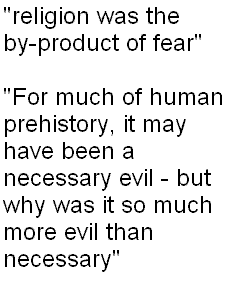
  • "religion was the by-product of fear - a reaction to a mysterious and often hostile universe. For much of human prehistory, it may have been a necessary evil - but why was it so much more evil than necessary". "I said evil - and I mean it, because fear leads to cruelty".
  • "obvious madmen, century after century, will proclaim that they - and they alone! - had received messages from God. If all the messages had agreed, they would have settled the matter. But of course they were wildly discordant - which never prevented self-styled messiahs from gathering hundreds - sometimes millions - of adherents".
  • "most of the humanity has always been insane, at least some of the time".
  • "There's never been anything, however absurd, that countless people weren't prepared to believe, often so passionately that they'd fight to the death rather than abandon their illusions. To me, that's a good operational definition of insanity."
  • "Do you believe in ghosts, Dim?" "Certainly not: but like every sensible man, I'm afraid of them."
Fact sheet.
3001 The Final Odyssey, novel, review
Author: Arthur C Clarke
Genre: Fantasy
First published: 1997
Rating: B

See also:
  1. "Space Odyssey series summary"
  2. "Influences" section of "Rescue Party"
  3. The ring habitat connected to earth with many spokes around equator that are space elevators that we see in first one third of this story also appears at the end of "The Fountains of Paradise". But there, we see it in about 4000 AD, & without details of its interior.
  4. "The City & the Stars", a much earlier novel, has a religious discourse about its middle that is essentially the same as that in the middle of this book.
  5. "Imperial Earth" is another Clarkian story that describes human life about the year 3000 AD. I personally find Imperial Earth's descriptions far more realistic.

Tuesday, April 10, 2007

"If I Forget Thee, Oh Earth ..." (short story): Sad & nostalgic

One of the less entertaining stories by Clarke. It is yet another of the many doomsday stories in the aftermath of World War II - dealing with radioactive destruction of earth.

Story summary (spoiler).

Story is almost entirely descriptive & flashback, with few dialogs. In the Armageddon, all life on earth is destroyed. Only human survivors are those living in a colony on moon. Story is told through the eyes of a 10 year old, & is essentially a wistful longing for the world that was.

See also.

  1. Other stories with nearly the same subject matter: Ray Bradbury's "There Will Come Soft Rains", & Arthur Clarke's "The Curse". Bradbury's version is the lightest read.

Fact sheet.

"If I Forget Thee, Oh Earth ...", short story, review
Author: Arthur C Clarke
First published: Originally "written at Christmas 1950", & published in Future, September 1951
Rating: C

Collected in.

  1. "The Collected Stories of Arthur C Clarke"
  2. "Expedition to Earth"
  3. "Of Time and Stars"
  4. "Across the Sea of Stars"

Saturday, April 7, 2007

"The Sentinel" (short story): Yet anoher ET beacon

A very average aliens' story. The story is set in sometime in 1990s (now we know, of course, that he was too optimistic).

An MP3 version of this story is available online (link via SF Signal & Free SF Reader).

Story summary (spoiler).
A local expedition off one of the permanent human bases on moon stumbles upon a machine on earth side of lunar surface that is found to be a beacon planted by ETs. Measurement of the depth of cosmic dust around the beacon dates it to a time before there was any kind of life on earth.

Not only has the machine stayed there all these eons, it appears to be still in perfectly working condition. And it is shielded in ways that frustrates examination by curious humans. So the foolish human adventurers blast through it with some kind of atomic fuse - only to discover the interiors totally beyond their grasp.

Story ends with this speculation: The ETs must have planted many such beacons across the galaxy near worlds that promise intelligent life in future. And ETs probably assumed that the curious explorers will do something foolish - switching off of beacon is probably a signal to them that it's time they come & have a look. So the smarter of the humans await the arrival in fear - for the ETs are an old race, & old are normally jealous of the young!

Note there is another Clarke story where ETs plant a beacon on moon to monitor evolution of intelligence on earth: the second of the four stories in "2001 A Space Odyssey".

Note (12 April 2007): According to this Wikipedia article, this story was 'written in 1948 for a BBC competition but first published in 1951 under the title "Sentinel of Eternity"'.

Collected in.

  1. "The Collected Stories of Arthur C Clarke"
  2. "Expedition to Earth"
  3. "Of Time and Stars"
  4. "Across the Sea of Stars"
  5. "The Sentinel (collection)"
  6. "More Than One Universe"
  7. "The Lost Worlds of 2001"
See also.
  1. "What Goes Up": An industrial accident on earth creates a field very similar to the shield protecting the alien beacon on moon in Sentinel.
Fact sheet.
The Sentinel, short story, review
Author: Arthur C Clarke
Genre: Fantasy
First published: 1951
Rating: C
Listed in Contento's Top Ten Most Reprinted Stories.

Thursday, March 29, 2007

"A Fall of Moondust" (novel): Engaging thriller

Review of the novel titled A Fall of Moondust by Arthur ClarkeAmazingly, this 45 year old science fiction thriller still doesn't feel dated!

It is a fast moving & very engaging shipwreck & rescue story, set in an extremely exotic locale - neither land nor water, neither air nor space! Sounds like old Indian story of Hiranyakashapu - you will neither die indoors nor outdoors, neither during day nor night, neither killed by a man nor beast ...

This book actually could have been a bit smaller. There are some movie style scenes that dramatize things a bit too much, & help prolong the book. But overall, extremely enjoyable.

Fact sheet.
A Fall of Moondust, novel, review
Author: Arthur C Clarke
Genre: Science fiction, thriller
First published: 1961
Rating: A
Hugo Award nominee in novel category in 1963

See also.

  1. "Maelstrom II": Another very good & off-beat wreck & rescue story on moon.
  2. A shorter version of somewhat similar wreck & rescue appears as a sub-plot in "The Sands of Mars" when you are about two thirds through that book.
  3. Robert Heinlein's "Searchlight" is a similar shipwreck & rescue drama on moon.
  4. Larry Niven's "At the Bottom of a Hole" describes thick layers of fine dust on Mars that behaves like is fluid & is opaque to aerial surveillance. This is very similar to moon dust where the revelers' ship in this Clarkian story sinks. But this dust is only a minor feature in Niven's story.
  5. All of Clarke's "shipwreck & rescue stories", "thrillers"; other sf authors' shipwreck & thriller stories.
  6. All Hugo Award stories.