Showing posts with label space travel. Show all posts

Friday, June 22, 2007

Paul Preuss' "Arthur C Clarke's Venus Prime, Volume 1" of 6 (novel): "Breaking Strain" expanded

Review of the novel titled Arthur C Clarkes Venus Prime, Volume 1 (of 6) (Breaking Strain) by Paul PreussThis is not a story by Clarke. But by Paul Preuss, probably under some kind of royalty agreement with Clarke.

This also is not the expansion of a short story into novel length in the sense that "Rescue Party" was transformed into "The Songs of Distant Earth" - that requires hard work. This is simply an attachment of a kind of preamble & postscript to original "Breaking Strain". Preamble takes up first 30%; postfix later 50%; rest is original story with very minor tweaks to fit the two new parts.

What was an accident in Breaking Strain becomes sabotage to a very lame cause. This volume came out of marriage of original short story with a computer game script; the overall tone (except for original story portion) appears to be meant for younger audiences.

Assuming this is typical of the Venus Prime series, I doubt I will be bother with rest of the series.

Story summary (spoiler).
Story has three plots intertwined - not always seamlessly.

First is the original "Breaking Strain". While I have not physically compared the version here with original story, I was getting a feeling it is pretty much a verbatim copy. Only beginning & end seem to have minor tweaks to link it up with preamble & postscript. This sits in the middle of the story, as a single block.

Second is the story of heroine - Ellen Troy aka Sparta aka Linda (probably also has more names). She is the one who will link the Venus Prime series. She is a victim of an innocuous experiment in psychology that was started by her parents to produce geniuses - with good intentions.

The project (SPARTA) was later hijacked by some security agency of US government to turn her into an invincible biot that will do the bidding of her masters. Experiment failed, & the powers controlling her tweaked her brain to make her forget everything. Result was - she turned into a vegetable that cannot even take care of her own needs - so these masters are safe with their secret.

Through benign intervention of someone on the project that cares for her, she regains consciousness. Since she is an immensely capable superwoman, she escapes in spite of security agencies tracking to destroy her.

Through the ordeal, she has lost most of the memory of her preceding 3 years. Also, her parents have vanished. She is 20 or 21 year old at this time. This entire story oocupies may be first 15% of the book.

Ellen's story continues in bits throughout rest of the story (& probably in rest of series) as parts of her memory return, in her effort to track her parents down, & the way she frustrates the efforts of security agencies out to kill her.

Third plot element is the conspiracy involving sabotage to the space ship involved in accident (original story treated it as an accident involving a meteor strike). This story has very lame motive, & I found it completely uninspiring.

Preamble is set on earth; postfix is set on Port Hesperus - a man-made space habitat with population of 100 thousand oribiting around Venus. Economy of this artificial habitat depends on mining Venus using robots.

Ellen is involved in this third plot as the main crime investigator. Of course, culprit is caught.

Fact sheet.
Arthur C Clarke's Venus Prime - Volume 1 (of 6), novel, review
Author: Paul Preuss
Rating: B

See also.
1. "Breaking Strain" - original story by Clarke.

Wednesday, June 6, 2007

"Islands in the Sky" (novel): Description of futuristic space stations

Review of the novel titled Islands in the Sky by Arthur ClarkeVery readable space adventure, but with a somewhat filmy presentation.

Story summary (spoiler).

This story is set in the mid twenty first century (or is it late twenty first - I forget). Told mostly in first person, it describes the adventures of a young man in near earth space & on a trip around moon - over a period spanning a few weeks.

Main protagonist, Roy Malcolm, wins an all-expenses-paid trip to "Inner Station" by winning a television quiz. This Inner Station is a space station about 500 km above earth, & is a kind of fueling & maintenance depot for space ships. Travel between earth & Station is via rocket powered machines that are somewhat advanced versions of NASA's current space shuttles.

This space station, & others described, don't look like the kind we normally read about. But the claim is they are realistic, if futuristic.

About half the story is a description of this station, & life aboard it. There are far more human interest elements here than in "Rendezvous with Rama" - another novel that is chiefly the description of a machine. Among the many generally interesting events & devices is the shooting of a movie in space that occupies not insubstantial part of this first half.

An interesting device described is a solar electric generator that doesn't use photo-voltaic elements, but a curved mirror to focus heat at a point - to heat water that will then be converted to electricity via a steam based generator! The mirror reminded me of the lens I sometimes used as a child to concentrate solar heat to make burn marks on dry twigs.

Much of later half of the story is adventure travel to other space stations & around moon in circumstances that are often very filmy. We are given a tour of a space station that is a hospital & a biology research center, much above the orbit of Inner Station. We are also shown how tiny earth creatures can grow to huge sizes in zero gravity conditions.

Next is an accidental trip around moon as part of a journey from hospital station to Inner Station! Here we are introduced to a new kind of space launch device: a kind of magnetic rail - several km long, with one end open, on the surface of the moon. To launch a payload, you accelerate it to moon-escape velocity & let it fall off open end! Because moon has much more curvature than earth, if enough velocity is given, the payload goes to space! No rockets!

We then go to one of the three Relay Stations in geosynchronous orbit - the kind of radio communication relays Clarke is often credited with first describing. Only they don't look anything like communications satellites we are familiar with. Also, in the scheme here, only 3 huge devices (and manned space stations at that) live in this orbit, 120 degrees apart - giving coverage over entire earth's surface. Presumably, some kind of UN agency must be running them, though it is not mentioned.

A few days after return to Inner Station, our friend must leave for earth via a space hotel - a machine very similar in concept to Rama, along with a swimming pool that is essentially a smaller version of Rama's cylindrical sea.

We are told Mars, Venus & Moon are now inhabited. This hotel, located in orbit of Inner Station a few kilometers away, provides three levels of Rama-style gravity - earth level, two thirds of it, & one third of it. This is used by travelers from smaller worlds to adjust to earth's higher gravity. Our friend will have to readjust as well, because he has spent some weeks in zero gravity.

In between, there are two stories told by people other than Roy.

One is a manned trip to Mercury's "night side". I am not sure the latest data supports the assumption that Mercury always shows same face to Sun, but this is an old story. We also meet an animal native to Mercury here!

Other story is of Martian colony. Chief highlight of this story is to tell us that current novel is kind of a sequel to "The Sands of Mars" - the story assumes background set by Sands.

One thing that was very obvious from this story, & also some other space travel stories of Clarke as also the Wikipedia article on NASA space shuttles, is something very familiar to every Mumbaikar: humans tend to litter when they are not being watched.

There are probably a lot of meteorites floating in earth orbit & in space that are man made, as also some of the stuff falling from the sky. You don't need something anymore? Just jettison. With luck, nobody will get hurt. At least not often enough for substantial court settlements! I am getting sympathetic with environmentalists!

Fact sheet.

"Islands in the Sky", novel, review
Author: Arthur C Clarke
First published: 1952
Genre: Science Fiction
Rating: A

See also.

  1. "Rendezvous with Rama" (novel): Both stories are essentially about the description of a machine. Also, the space hotel near Inner Station is very similar in design to Rama, though of much smaller size.
  2. "The Sands of Mars" (novel): There is a hint Islands is a kind of sequel to Sands.
  3. Robert Heinlein's short story "Misfit" (1939) is about construction of space station, but at a scale much grander than Islands. And Heinlein's station won't orbit earth, but sun - between the orbits of earth & Mars - to support interplanetary traffic.
  4. "Maelstrom II" (short story): Shares a small plot element with this story - space launches on moon via electromagnetic rail based catapults.

Tuesday, May 22, 2007

"The Sands of Mars" (novel): Optimism galore, & very readable

This will easily qualify as among the best stories by Clarke - particularly the last third, or may be the last half. Be happy, & do the best you can - and gods will generally smile back! Sounds like Gita!

And by & large, it is a down to earth story, in spite of native Martian animals, technology to create a sun, & a few other exotics.

Story summary (spoiler).
Main story is about terrafarming Mars - by increasing oxygen content of local air to enable humans to live in the open.

There are three parts to the plot: a space voyage from Earth to Mars where new human colony is struggling to become self-sufficient; a skeptic's view of possibilities offered by the colony, & his conversion to their cause; & finally the terrafarming.

In between, there are sub-plots involving discovery of native Martian animals, Martian plants, a shorter version of "A Fall of Moondust", & a short romance.

I got a feeling that first third is partly autobiographical, though Clarke never says so.

Main protagonist, Martin Gibson, is a well known science fiction author. He is offered a free passage on the maiden run of Ares, a passenger liner between Earth & Mars. Expectation is to use his writing on the experiences as PR material by the firm running the ship.

There are detailed descriptions of by-rocket travel to space station in Earth's skies; transfer to liner; liner interiors & crew; an adventure mid way through; landing on one of the Martian moons; travel down by another rocket; & architectural details of the Martian city ("Port Lowell").

Gibson was not exactly a welcome visitor, but colonists accept the visit with grace. Middle third is about his conversion to someone who believes in the Martian story. If you have worked in half decent startup, you should have no difficulty associating with the process of conversion.

Last one third is about a mega-project ("Project Down", if I recall correctly) that is also super secret, except that the secret is revealed about midway through this mystery story - if you are paying attention. Though I had not guessed the exact form the new heat source will take.

Key characters.

  1. Martin Gibson: Main protagonist.
  2. Jimmy Spencer: Son of Gibson.
  3. Warren Hadfield: Man in charge of "Port Lowell", one of the two cities on Mars. Most of action on Mars happens here. I forget the name of the other city.
  4. Mayor Whittaker: Assistant to Warren.
  5. Irene - Jimmy's girlfriend, & Warren's daughter
Fact sheet.
The Sands of Mars, novel, review
Author: Arthur C Clarke
First published: 1951
Genre: Science Fiction
Rating: A

See also.
  1. A small part of "Islands in the Sky", near end, suggests Islands is a sequel to Sands.
  2. In "2010 Odyssey Two", aliens convert Jupiter into a sun - Lucifer - to terrafarm Europa, a moon of Jupiter. Here humans convert Phobos, a moon of Mars, into a sun to terrafarm Mars.
  3. A sub-plot at about two thirds through the book involving a plane crash is almost a mini version of a "A Fall of Moondust". Robert Heinlein's "Searchlight" is also a similar shipwreck short story, but on moon.
  4. "The Songs of Distant Earth" is the only other Clarkian novel I have read that shows this level optimism - though there is no doomsday scenario in this book.
  5. First one third of the book appears to be autobiographical in the spirit of Hindi movies Aandhi & Guru - a highly fictionalized & dramatized account! The movies are in no way related to this book - except general tone. Note that Clarke never mentions of any autobiographical content - I am just guessing.

Saturday, May 19, 2007

"Imperial Earth" (novel): Good book, notwithstanding the juvenile title

I kept postponing this book because of title. Sounds like one of those space empire stories. But the title is totally inappropriate. This is a story about very ordinary politics & diplomacy, in a rather exotic environment. And quite readable.

Story summary (spoiler).
There are three parts to the plot: a description of the life in a human colony on Titan (a moon of Saturn); a description of space voyage from Titan to Earth in a passenger liner; & the life on earth just a little before the year 3000 AD - time where the story is set.

Note that "3001 The Final Odyssey" is also set about the year 3000 AD. But I find Imperial Earth's descriptions far more realistic. In spite of rocket engines powered by man-made black holes, & people on earth living underground because it is much cheaper to melt the earth's crust than build over ground structures!

Duncan, the main protagonist, is a third generation clone & Titan resident. His grandfather clone made the colony viable by mining hydrogen far more cheaply there than on earth; & hydrogen is a popular jet propellent used in interplanetary ships. The family is very powerful among the Titan's ruling elite.

The voyage to earth is in a cylindrical (I think) ship with multiple levels (7 or 10 levels, I think). Aspects of voyage are described in painstaking detail, reminiscent of "Rendezvous with Rama" - though Rama was a very different kind of ship & story.

And this ship is powered with an engine that contains a tiny man-made black hole that sucks in large quantities of hydrogen, & releases energy that is then tapped!

Description of life on earth of about 3000 AD is fantastic (of course), but far less fantastic than in "3001 The Final Odyssey". We are also given a tour of Titanic, the ancient lost ship that has now been hauled from Atlantic bottom to New York & is a museum piece.

Among the many other wonders are a visit to a lagoon in Mediterranean with bio-engineered marine life that can mine gold from sea water (aka "The Man Who Ploghed the Sea"), & a design for supermassive antenna (comprising of linear elements) to search for extra-terrestrial life that will work on one of the outer moons of Saturn, but no closer to Sun, because of solar effects.

Key characters.

  1. Duncan Mackenzie: Main protagonist, a third generation clone, & a member of the first family of human colony on Titan.
  2. Karl: Minor role as a friend of Duncan; but their relationship is a love/hate mix.
  3. Calindy: Common girlfriend of Duncan & Karl. Said to be a very smart woman.
  4. George Washington: Guide of Duncan on earth.
  5. Malcolm Mackenzie: Grandfather clone of Duncan, & a business & political hero on Titan.
  6. Colin Mackenzie: Father clone of Duncan.
  7. Aunt Ellen: Separated wife of Malcolm, & aunt to Duncan. Minor role.
Fact sheet.
Imperial Earth, novel, review
Author: Arthur C Clarke
First published: 1976
Genre: Science Fiction
Rating: A

See also.
  1. "The Man Who Ploghed the Sea": This novel includes a variant of this story. Rather than a mechanical device that can mine arbitrary metals from sea water, this novel has a story of genetically engineered marine life to mine gold from the sea water.
  2. "3001 The Final Odyssey": This novel also describes the life around the year 3000 AD. But I find the Imperial Earth description more realistic.
  3. "The Ghost from the Grand Banks" has a Titanic salvage operation that will eventually make it a museum piece in Florida in US. Imperial Earth not only has a chapter titled "The Ghost from the Grand Banks", it actually has salvaged Titanic as part of a museum in New York.

Saturday, May 12, 2007

"Loophole" (short story): Government bureaucracy doing what it does best - push the papers!

This engrossing piece of satire is written in a somewhat unconventional style - as a series of memos between government officials & departments.

Story summary (spoiler).
Martians have had a technology civilization for a while, while humans are still at a rather primitive stage. With advent of radio on earth, Martian government have been monitoring the development of earthlings.

That is when they detect the three US nuclear explosions - an initial test, & the two bombs dropped on Hiroshima & Nagasaki. A little later, they detect rockets being tested by earthlings.

They decide to act. Several Martian spaceships reach earth, & issue a warning: stick to earth, or face the consequences. No rockets & space exploration allowed for such violent beings.

We are told of above proceedings in the form of memos moving around in Martian bureaucracy - usually with very comic contents.

In the final act, we see the Martian civilization decimated. It seems, the earthlings invented Star Trek style material transporters when rockets were barred! And used that for attack Martians.

End is again a bit of humor, as the victorious earth soldiers on Mars are not too keen on traveling at speed of light via the beam, but would rather prefer rocket travel, & want earth to develop it for their transport!

See also.

  1. "Travel by Wire!" (1937) (A): This story about a Star Trek type device to beam people & things around has an ending that shares sentiments of returning soldiers in Loophole. One of the inventors of beaming machines who is also behind the big electronic transportation empire prefers traveling the old fashioned way!
Fact sheet.
Loophole, short story, review
Author: Arthur C Clarke
First published: 1946
Genre: Humor
Rating: A

The story appears in the following collections.
  1. "Expedition to Earth"
  2. "The Collected Stories of Arthur C Clarke"

Saturday, April 28, 2007

"Jupiter Five" (short story): Precursor to "Rendezvous with Rama"

This story obviously leads better known "Rendezvous with Rama" - there are just too many similarities. This story also has elements that will be seen in the 3 sequels of "2001 A Space Odyssey".

Story summary (spoiler).
Like Rendezvous, we have an alien spaceship in our solar system with kilometer scale dimensions. Like Rama, this is a complete independent habitat including its own sea. Like Rama, it has traveled for untold number of years through interstellar space. Like Rama, number 3 is important to these aliens - e.g., the ship's hull comprises of 3 layers.

Unlike Rama, this ship is spherical rather than cylindrical in shape, & has multiple entrances rather than only one. Also unlike Rama, it is dead & has been dead for several million years.

And, for a change, the aliens are not tentacled but reptilians, as in "History Lesson".

But by & large, the story is in the same style & tone as Rendezvous.

Last third is just a mundane fight of wits, & could have been dropped from story without any effect; it just prolongs the story. Or may be it is a precursor to 3 Rendezvous sequels; there are similarities with those sequels.

You get a preview of Odyssey sequels in the form of voyage to Jupiter, & a stopover at Ganymede.

Quite a readable story, but I prefer Rendezvous.

Fact sheet.
Jupiter Five, short story, review
Author: Arthur C Clarke
Genre: Science fiction
First Published: 1953
Rating: B

Series: "Jupiter Five" (A), "Rendezvous with Rama" (A), "Rama II" (C) , "Garden of Rama" (B), "Rama Revealed" (B)

The story appears in the following collections.

  1. "Reach for tomorrow"
  2. "The Collected Stories of Arthur C Clarke"
  3. "Across the Sea of Stars"
  4. "The Sentinel (collection)"

Thursday, April 26, 2007

"The Awakening" (short story): Man shall not inherit the earth!

Frankly, I am getting bored with Clarke's doomsday stories - there are just too many of them!

Story summary (spoiler).
Earth is so prosperous at this future date that boredom is the biggest problem. Too many men committing suicide because of lack of excitement in life.

Our hero, if you can call him that, decides to do something interesting. He gets a spaceship built, with an inner chamber that is essentially a machine controlled chamber for human hibernation.

He takes off into space, parks himself into a solar orbit beyond Pluto, & goes to sleep in the hibernation chamber. The machines controlling hibernation chamber have instructions to awaken him unfathomable eons hence; ship likewise has instructions to bring him back to earth after awakening.

At the time of awakening, something in the machines fails; he is not awakened really, but stays in hibernation.

Ship faithfully brings him back to earth. But earth has changed unrecognizably. Gone are its seas, Alps, & Himalayas. Also gone is the moon - it crashed into earth at some time in far away past (I was taught that moon is moving away from earth, a few centimeters a year!)!

Well - the ship lands at the best site it can find. Some members of the current master race of earth come, awaken him using their technology but only for a while. And he realizes it is not the man that inherits the earth, but ...

Fact sheet.
The Awakening, short story, review
Author: Arthur C Clarke
Genre: Fantasy
First Published: 1951
Rating: C

See also.

  1. "The Parasite" - another story of a prosperous future human society with bored individuals. But the two stories are developed very differently.
The story appears in the following collections.
  1. "Reach for tomorrow"
  2. "The Collected Stories of Arthur C Clarke"

Tuesday, April 24, 2007

"Rescue Party" (short story, free): First of Clarke, also mother of all his stories

According to Clarke's opening remarks in the story collection "Reach for Tomorrow", "Rescue Party" is not only his first published story, but shares the roots with another story - "History Lesson". Also see the note on first story near end of this article.
After reading it, I am getting a feeling that this also is the mother story of all of Clarke's life. Just too many ideas in his later stories already appear here! And it must be among the most influential science fiction stories by anyone; see Influences section below.

Full text of this story is available online (link via Sf Signal & Free SF Reader). I've not read this online version.

Story summary (spoiler).
This doomsday story is set in about 2200 AD.

Sun is about to blast, & will take earth & rest of solar system with it. A kind of galactic administration of aliens not aware of the existence of humans suddenly learns two facts:

  1. That our Sun will burst - less than 10 hours before the event.
  2. That it contains a world inhabited by intelligent beings. It seems - these beings discovered radio 200 years back, & one of their transmissions has just been intercepted by a alien station 200 light years from earth.
There is a ship of galactic administration just about a billion miles of earth. It is entrusted with the job of rescuing what intelligent creatures it can from the doomed earth. It will have just about 4 hours on earth, after accounting for the time needed to reach it & then to escape.

Will they be able to help humans?

Influences.
I enumerate here those of Clarke's stories that carry influences from this story. Note that I haven't probably read even half of his total work - so this list will likely expand in future!
  1. Expand this story a bit, & you get "The Songs of Distant Earth". Another very similar story is "The Star".
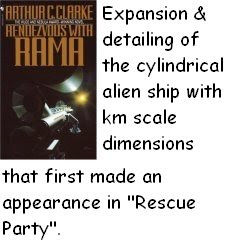
  2. Alien ship in question is a cylindrical one, with kilometer scale dimensions. Its elaboration will yield "Rendezvous with Rama". Plus the ships in its 3 sequels.
  3. "History Lesson" is similar in that Sun is changing in a way that dooms earth. But rather than exploding, it cools - to turn earth into an icy wasteland. But both the response of humans to the event, & story ending, are very different.
  4. In "History Lesson", aliens begin drawing funny conclusions about humans by interpreting the scenes in a movie reel. Something very similar happens here; early in their search on earth, they find a portrait of a man & begin wondering how the poor bipeds managed with just 4 limbs & 2 eyes - may be they have more eyes in the back not visible in this primitive 2D portrait!
  5. There is a brief mention of a black rectangle that gives the illusion of having infinite depth. This reminded me of the various Monoliths (TMAs) in Space Odyssey series.
  6. Tentacled aliens in this story might have morphed into octospiders seen in various Rama sequels.
  7. Galactic administration entrusted with their duties by powers beyond the beginning of time reminds me of the end of "Rama Revealed". The powers beyond the beginning of time also appear to be indistinguishable from Brahma, the Creator, of Hindu Trinity (other two are Vishnu - the Executive, & Shiva - the Destroyer; these two don't have any avatars here).
  8. While beginning operation rescue humans on earth, these tentacled aliens carry a paralyzer because they will likely have to do forcible evacuations because of lack of time. In "Rama Revealed", octospiders actually use paralyzers when they "kidnap" a woman.
  9. Galactic survey ship, & the survey administration, here is very similar in concept to the one in "Encounter at Down".
  10. Aliens keeping a watch on development of earthlings, among other promising beings across galaxy, is found in Space Odyssey series, & in "The Sentinel".
  11. Benign aliens helping intelligent beings everywhere in galaxy is an idea you also find in "2001 A Space Odyssey". Though its sequels somewhat dilute it.
  12. Anti-gravity devices mentioned here are also seen in "3001 The Final Odyssey", but with a different application - to power a spaceship.
I am also aware of some stories by Issac Asimov that have ideas very similar to those in this story:
  1. You find Issac Asimov's Gaia here, as Palador; one of his Foundation sequels - "Foundation's Edge" - introduced it; another of his novels - "Foundation & Earth" - further developed it. Another of Asimov's novels - "Nemesis" - also has a planet scale hive intelligence. Palador in this story is very similar to Gaia, not the one in Nemesis.
  2. The idea of a Sun blasting, & rescue of an entire planet, is also the theme of Asimov's novel "Currents of Space".
  3. Galactic administration described here could have been Asimov's Empire, though Clarke doesn't really elaborate the administration part. And Asimov's Empire was of human origin, & his stories on the subject focused mostly on the politics.
  4. I recall more than one of Asimov's sequels to Foundation series that had anti-gravity devices, though in different applications - as an ordinary elevator & a spaceship.
Trivia.
You get a feeling of the age of the story when you see mentions of "vacuum tubes" (as in computers), or of cupboards full of some 5 million punched cards! But they don't hamper readability.

Is it really the first story by Clarke?
When I originally wrote this article, I had referred to Clarke's "Reach for Tomorrow". Here is the quote: '"Rescue Party", which was written in 1945, was my first published story'. The publication actually happened a year later, in 1946.

I now (on 25 August 2007) hold in my hands "The Collected Stories of Arthur C Clarke". And here is the quote from introduction to first story in the book - "Travel by Wire!": "'Travel by Wire!' was my first published story."

Actually, the later appears right. "Travel by Wire!" was published in 1937 in Amateur Science Fiction Stories; "Rescue Party" was first published May 1946 issue of Astounding Science-Fiction.

Based on Clarke's other remarks introducing "Travel by Wire!", he seems to think this was published in one of the fan magazines while "Rescue Party" was in a mainstream publication; also that Travel is probably of lower quality than his later works. I actually find Travel to be among his best stories.

Fact sheet.
Rescue Party, short story, review
Author: Arthur C Clarke
Genre: Science fiction
First published: 1946 (in "Astounding Science Fiction")
Rating: A

Series: "Rescue Party" (A), "The Songs of Distant Earth" (A)

Collected in.
  1. "Reach for tomorrow"
  2. "The Collected Stories of Arthur C Clarke"
  3. "Across the Sea of Stars"
  4. "The Sentinel (collection)"
  5. "More Than One Universe"
  6. David Drake, Jim Baen, & Eric Flint (Ed)'s "The World Turned Upside Down"

Saturday, April 21, 2007

"3001 The Final Odyssey" (novel): Somewhat anticlimactic

Quote from the novel 3001 The Final Odyssey by Arthur C ClarkeThis book is almost entirely fantasy rather than science fiction. Except a few pages of rather reasonable philosophical discourse about mid-way through the book, & that too is borrowed from similar discourse in "The City & the Stars". And in spite of the finality of the title, the end of the story leaves a lot of scope for further sequels.

Also, this book liberally copies whole passages from previous books in the series.

Story summary (spoiler).
First one third of the book is a kind of time warp: imagine you moved 1000 years ahead in time; how would you react to human society of this future. There have been perhaps a half dozen movies on the subject - both in Bombay, & in Hollywood. But Clarke is creative. Cannot fault him for borrowing from these movies.

Among the many devices described here, you find a mention of space ships that use "anti-gravity", a technology that first appears in "Rescue Party" - the mother of all Clarke stories.

Middle one third is generally slow paced: a voyage from earth to Ganymede, & a little excursion from Ganymede to Europa. Sole interesting part of the book is in the middle of this section - a short philosophical discourse on human nature; I copy some quotes below.

Note that a similar voyage to Ganymede, & then to another moon in Jupiter system, also happens in "Jupiter Five" - the story that will ultimately become "The Songs of Distant Earth".

Last third is about as fantastic as the last story in 2001. Unimaginably powerful gods are humbled by humans!

Last third also partially explains the discrepancy in the series so far: around 22,000 AD, Europans are at about the level of stone age humans in development, & Lucifer is shining. But in 3000 AD, Lucifer has stopped shining! We are now told this "stopped shining" was a temporary phenomenon that lasted only a few hours - as humans outwitted gods.

There is still a discrepancy remaining in the series. If humans outwitted gods in 3000 AD, how come Europans are still happy & safe from humans on Europa in 20,000 AD; and still protected by TMA in Europa that vanished when humans attacked gods in 3000 AD! But as Clarke explains towards the end of this book - it is fiction written over three decades. Don't bother with discrepancies. Enjoy the stories, instead of doing nit picking.

Quotations.
Quotes below are all taken from a little philosophical discussion near the middle of this book.

  • "religion was the by-product of fear - a reaction to a mysterious and often hostile universe. For much of human prehistory, it may have been a necessary evil - but why was it so much more evil than necessary". "I said evil - and I mean it, because fear leads to cruelty".
  • "obvious madmen, century after century, will proclaim that they - and they alone! - had received messages from God. If all the messages had agreed, they would have settled the matter. But of course they were wildly discordant - which never prevented self-styled messiahs from gathering hundreds - sometimes millions - of adherents".
  • "most of the humanity has always been insane, at least some of the time".
  • "There's never been anything, however absurd, that countless people weren't prepared to believe, often so passionately that they'd fight to the death rather than abandon their illusions. To me, that's a good operational definition of insanity."
  • "Do you believe in ghosts, Dim?" "Certainly not: but like every sensible man, I'm afraid of them."
Fact sheet.
3001 The Final Odyssey, novel, review
Author: Arthur C Clarke
Genre: Fantasy
First published: 1997
Rating: B

See also:
  1. "Space Odyssey series summary"
  2. "Influences" section of "Rescue Party"
  3. The ring habitat connected to earth with many spokes around equator that are space elevators that we see in first one third of this story also appears at the end of "The Fountains of Paradise". But there, we see it in about 4000 AD, & without details of its interior.
  4. "The City & the Stars", a much earlier novel, has a religious discourse about its middle that is essentially the same as that in the middle of this book.
  5. "Imperial Earth" is another Clarkian story that describes human life about the year 3000 AD. I personally find Imperial Earth's descriptions far more realistic.

Wednesday, April 18, 2007

Hide-and-Seek (short story): Adventure on Phoboes

Story summary (spoiler).
This is quite an entertaining little account of a chase in exotic surroundings. One very resourceful man, alone on Phobos - the tiny moon of Mars, being chased by a heavily armed adversary & winning.

There are some detailed descriptions of Phobos, & somewhat dated descriptions what you would see on Mars from there.

Not a bad reading.

Fact sheet.
Hide-and-Seek, short story, review
Author: Arthur C Clarke
Genre: Thriller
First published: Astounding Science-Fiction, September 1949
Rating: A

The story appears in the following collections.

  1. "The Collected Stories of Arthur C Clarke"
  2. "Expedition to Earth"
  3. "Of Time and Stars"
  4. "Across the Sea of Stars"
  5. "More Than One Universe"

Tuesday, April 17, 2007

"Transience" (short story): Good prose, but ...

This must be among the few somewhat confused stories by Clarke.

This doomsday story talks of earth's destruction, along with that of rest of solar system, & the coming & going of man without the slightest effects on the universe in the long run. That is theme behind the title.

Story summary (spoiler).
Of the four parts in the story, first is by far the most interesting. Tentative exploration of the world by a child who could have been the son of Moon Watcher in "2001 A Space Odyssey" - at the down of human history.

For the most part, it is not a sad story. For, the story is told through 3 young children, each playing alone on the same beach, but across vast gulfs of time. First is the child from the down of humanity. Second is a modern human child. Third is the child of among the last people to leave earth - for some unknown & safer destination.

There is not much given by the way of explanation as to why this doomsday is coming. Two pieces of news are offered:

  • Solar system has moved close to the center of galaxy, from it familiar position far in one of the arms of the spiral. Why? Don't ask me.
  • "Dark Nebula", whatever that is, is slowly creeping towards solar system. Or may be it is the other way around. Anyway, the two are about to meet. Since nebulae are where the new stars are born, our solar system will apparently become raw material from which the mother nature will shape new worlds eons hence.
I recall an Asimov novel where humans colonize a star system inside a nebula - to hide things from mainstream humanity. How come one nebula is so benign, & other so dangerous? Don't ask me.

I liked the part where the world is seen through the eyes of the first child. Other two are rather average. End is decidedly boring.

Fact sheet.
Transience, short story, review
Author: Arthur C Clarke
Genre: Fantasy
Rating: B

The story appears in the following collections.
  1. "The Collected Stories of Arthur C Clarke"
  2. "More Than One Universe"

Sunday, April 15, 2007

"Superiority" (short story): Dilbert in prose

Every time I begin to get bored with Clarke's stuff, he throws in a surprise. This is an outstanding & hilarious comedy - probably the best single story I have read yet of Arthur Clarke.

He anticipates Dilbert by decades. If you manage a business or a project, you will find a lot you can relate to. It also is a story about rolling out new technology in an enterprise - what the software industry calls deployment. A 1951 story still totally relevant today, wow!

Story summary (spoiler).
The plot is about a war. One side has vastly superior technology & financial resources - too superior for its own good! Other side wins by shear tenaciousness, & ruthless focus. Hare vs tortoise.

Comic situations are all on the superior side. They begin with vastly larger number of war machines, their machines are more efficient too, & they have been the winning side till now. And then they get a new technology head - a true geek.

Now this geek looks at deployed war machines, & wonders why we are still using 100 year old technology - only innovations, of late, in weapons have been minor tinkering. Cannot we change the paradigm, & quickly end the war?

He convinces the generals to instead use his new weapon, the "Sphere of Annihilation". When activated, it makes all matter within several hundred meters of it vanish. Demonstrations are very convincing. Deployment begins. Ouch - it annihilates its own ship! OK - so then need to be mounted on missiles. But existing missiles cannot carry its heavy load - need minor improvements, etc. You get the idea.

On the battlefront, war situation has been changing. Enemy is not only sticking to old technology, they have been producing those weapons in great numbers.

No problem, the geek says. He has yet another weapon that can compensate for loss of advantage in conventional weaponry, while the Sphere is undergoing teething troubles. It's "Battle Analyzer" - a computerized system that can double the effectiveness of a conventional warship.

When the Analyzer deployment begins, we begin seeing little issues. This machine needs some 500 odd technicians to operate. We need to both train the technicians, & make space for them on the warship. Of course, fewer numbers are actually trained than planned. And to house the additional technicians not on duty, an unarmed liner will accompany the equipped warships. Of course, the enemy quickly figures out the simple way to win - destroy the liner.

Battlefront situation has become grim for the superior side; enemy is knocking on their own door.

Ever an optimist, our geek produces yet another wonderful weapon - "The Exponential Field". It is both defensive & tactical. On the press of a button, it distorts the space around its location in a way that you effectively move far away along a fourth spatial dimension - relative to your physical neighborhood when field was not active.

How do you use it? When cornered, you activate the field, & vanish! When attacking, you suddenly appear in the midst of the enemy & surprise them. Wonderful. Only there is a little glitch. After a couple of uses, deactivation leaves you a little away from target, & the various precision systems on board have been failing - including intership communications.

Some debugging sessions later, we are told the deactivation doesn't move all matter displaced to exactly the original location; there are computational errors. Original particles of matter have moved very slightly around relative their immediate neighborhood. This, of course, kills all electronics. We are not told why it doesn't kill the humans on board, but why do nit picking?

I am not complaining. Fantastic story.

Trivia.
When introducing this story in "The Collected Stories of Arthur C Clarke", Clarke mentions the inspiration rooted in World War II: "German V2 rocket program" - an inter-continental ballistic missile program, too late to influence war & sapped resources - made Germans as the superior side; Allies were the inferior side that won.

Fact sheet.
Superiority, short story, review
Author: Arthur C Clarke
Genre: Humor
First published: Magazine of Science Fiction & Fantasy, August 1951
Rating: A

The story appears in the following collections.

  1. "The Collected Stories of Arthur C Clarke"
  2. "Expedition to Earth"
  3. "Across the Sea of Stars"
  4. "More Than One Universe"
See also.
  1. Eric Frank Russell's "Allamagoosa" (A), & James P Hogan's "Making Light" (A): Other lovely Dilbertian tales, but about organizational bureaucracy. Similar tone.
  2. A device that lets you move along a fourth spacial dimension also features in Arthur Clarke's "Technical Error".

"2010 Odyssey Two" (novel): Generally a worthy sequel

This is the first of the three sequels to "2001 A Space Odyssey". Going by experience of his "Rendezvous with Rama" sequels, I avoided this one for quite a while. But this book is generally good.

There is a key change in continuing the narration from 2001: the mysterious alien artifact (TMA-2) is not on a satellite of Saturn, but is hanging in space between Jupiter & its innermost volcanic satellite Io. According to Clarke, this is to ensure this sequel is consistent with the original movie rather than original novel.

Story summary (spoiler).
It is convenient to look at this book as generally four stories - though they are far more tightly coupled than the stories of original 2001 were. Let me name them, for Clarke doesn't:

  1. International diplomacy & voyage to Jupiter
  2. Ghosts & gods
  3. Gods at Creation
  4. Europan (not European) gods
First story, international diplomacy & voyage to Jupiter, is the longest.

Americans are building a manned spaceship in earth orbit that will go to Jupiter, rendezvous with the spaceship Discovery left near the alien artifact in 2001 - to figure out what was known to that ship before contact was lost, & then again investigate the alien object for its secrets.

Russians are also building their own ship to investigate alien object. They missed out last time because Americans kept the secret to themselves for too long. And looks like they will end up finishing much faster than Americans.

Russians want American help to board Discovery, & to learn what is there in the data banks of that ship about aliens. Americans are not interested, till Russians come up with a trump card - Discovery is off orbit, & will fall into volcanic Io long before Americans can get there by their own efforts.

OK - so a Russian ship will go, with mostly Russian crew, but also 3 Americans - including the TMA expert, the man who programmed the robot (HAL 9000) that ran amok in 2001, & an engineer familiar with Discovery.

There is a silly part in voyage arrangements: Russians will travel normally, but Americans will travel in hibernation. Why? I guess Clarke just wanted to introduce yet another technology into narration; story would only have been cleaner without it.

Anyway, the Russian ship is approaching Jupiter, & American TMA expert is woken up. They are quite close to Jupiter, when the first twist comes.

Chinese have also been building a ship headed towards Jupiter, & they have technology far ahead of either Americans or Russians. This Chinese ship, Tsien, comes from behind, overtakes our friends, circles Jupiter, & lands on its icy moon Europa.

Our friends figure out why - to pick up water as propellant. Only the Chinese have other designs - they cause a diplomatic stir on earth by claiming Europa as Chinese territory. It seems, because of easy accessibility & easy availability of water, Europa could be an important refueling station for deep space exploration.

But Chinese have something larger than them up against them. Turns out, Europa has life - though primitive - in liquid seas under its icy surface. One such life form - half tree, half animal - manages to destroy Chinese ship & kill the crew. The man last to die sends a detailed report.

OK - tangent taken care off, our men head for the target. Dumbbell-shaped Discovery is boarded, fixed, taken to a safe orbit above Io, & the robotic HAL is fixed. And it has no clues to TMA-2 sitting close by in space.

Oh - TMA-2 has been renamed by now. Americans call it Big Brother; Russians by some other name I cannot recall.

All observations & probing of TMA proves futile, as in 2001. Our friends watch with infinite patience. Until TMA opens momentarily & lets out a mysterious lit object that can only be called a UFO.

Hence begins the tale of ghosts & gods, the second story. This is the worst part of the book, but thankfully it doesn't last long.

UFO is actually the American astronaut David lost in 2001 as he went into TMA, was taken for a ride by aliens, & turned into a pure energy being - a star child. We are told he still retains some human emotions and attachments, & is being held tightly on leash by aliens that have their own ends in mind.

When the Russian ship relays the UFO information to earth, someone decides to prepare with a nuclear bomb. Star child quickly detonates it in earth orbit, killing a few on surface of earth, but human losses could have been worse.

Then there are some adventures of star child - on earth to old haunts of David that is no longer David, on Europa exploring the life forms in its seas, inside Jupiter right to its core that is solid diamond, we are told. There are graphic descriptions of living animals on Europa, & also on Jupiter.

Then begins the tale of Creation, & of kick-starting intelligent life by gods - the third story. I was occasionally reminded of first story in 2001, & also of Encounter at Down, but generally this is a different story.

Our friends on board Russian ship (that has now been joined with older American ship through a kind of tube) are losing patience. All efforts to map TMA are failing. So they are planning to do something drastic - like detonate a powerful device on TMA surface, but are wary of reaction from TMA to such hostile acts. They are awaiting the launch window - some 20-25 days hence, when they can begin their trip back home; doing otherwise would require more fuel that they don't have. Plan is to do these hostile acts just before setting out for earth.

Now our friendly ghost makes contact with the TMA expert. He warns him to leave within 10 days (or is it 15? I forget).

Shipmates are divided on the ghost version. Though the TMA expert has impeccable credentials & is in good health, the captain wants something more substantive. Over the days, the crew gets more & more divided - some in believing camp, others not believing, others on the fence. Situation is not helped by reports arriving from earth - of the exploits of the ghost there.

Russian captain has another headache - even if she agrees to leave, there is not enough fuel. But there is the brilliant American engineer on board. Old ship Discovery still has fuel. They will rig it as a booster stage rocket, use some help from Jupiter's gravity, & with some luck, can get home safely even outside the launch window.

And then comes the next twist in tale. One fine day, the TMA simply vanishes. Now even the unconverted are converted, & plans for return are finalized.

Another twist is cooking elsewhere. Astronomers from earth have observed a new anomaly on Jupiter's surface - looks like the shadow of a new moon! Just as our friends are about to leave, they get a request as to whether they can take some pictures.

Starting the trip back home involves many twists - including convincing HAL of the changed schedule. It is during this trip that the black plague on the Jupiter's surface is noticed by our friends. And it is spreading fast. It seems, TMA that vanished went to Jupiter, & has been making copies of itself by sucking up local materials. And it is growing fast.

Enter a conversation between ghost & now all alone HAL. Ghost convinces HAL to stop talking to retreating Russian ship, & instead relay a message to earth as many times as it can. The message is very brief, & is from gods to mere earthlings: all planetary bodies around are yours, except Europa; leave that alone. Looks like the gods have designs on Europan lifeforms, but consider Jovian lifeforms discardable!

This is when the explosion happens. It turns out the gods that control TMA are about to turn Jupiter into another Sun - by increasing its density, & starting the fusion reaction! The plan is: its heat will warm nearby Europa, & help evolution of intelligent life there. It will also make other moons of Jupiter, new called Lucifer in its sunny avataar, more habitable. These other moons will be gods' gift to mankind.

Incidentally, during this cataclysmic event, HAL became another star child while the old ship Discovery was destroyed. So now there are two ghosts of earthly origin on the loose. Will likely help out in future sequels.

Now begins the final tale, the forth one. Of new intelligent beings just discovering their own gods. The year is no longer 2010. It is twenty thousand something. And the voices & opinions we hear are of the Europans. Some species there have just become conscious of the universe around, including their main sun Lucifer, & the little far sun. And of mysterious stars & lights moving around in the skies.

There is a little silly element that can be ignored. The beings described appear to be roughly at a stage of development that humans were some 30,000 years back, or perhaps slightly older ancestors. Anyway, the evolution on earth took some billion years to reach this stage from primitive animals; on Europa, this huge time has been compressed to just 20,000 years!

We are told humans have been probing Europan landing via unmanned probes for a long time, in spite of warning from gods. Every time their ship approaches, it explodes & is destroyed.

And yes, there is a TMA-3, on the surface of Europa, protecting its creatures from humans. Who will inherit the solar system - humans or Europans?

Enough hints of a sequel.

Fact sheet.
2010 Odyssey Two, novel, review
Author: Arthur C Clarke
Genre: Fantasy
First published: 1982
Rating: B
Hugo Award nominee in novel category in 1983

See also.
  1. "Space Odyssey series summary"
  2. "Influences" section of "Rescue Party"
  3. Another story by Clarke, from 1940s, titled "History Lesson" has a similar quick evolution on another world - even quicker than Europa.
  4. Humans create a sun out of Phobos, a moon of Mars, to terrafarm Mars in "The Sands of Mars".
  5. All Hugo Award stories.

Saturday, April 14, 2007

"Inheritance" (short story): Space shuttle foreseen!

This is the third "shipwreck as primary element" story from Clarke I am reviewing, not counting Deep Range that had a shipwreck as a minor episode. After a while, it gets a bit boring!

And this story has a bonus shipwreck - so instead of usual one with happy ending, we have two wrecks here - one with happy & another with sad ending.

Story summary (spoiler).
A manned 2-stage rocket powered with chemical fuels is taking off, develops a snag 50 km above earth's surface where the booster stage refuses to separate. There is miraculous escape of both the rocket & the sole human occupant.

An interesting part of this first episode is: main payload rocket sounds a lot like NASA's modern space shuttles! Remember, this story was written in 1940s!

Second part is a bit of occult. While the hero is recovering from minor injuries sustained in accident, he confides to colleagues what kept him completely confident that he was not about to die after he became aware of the snag. It seems, he has been having dreams where he is in a curious cabin with funny controls & displays with 3 others, all in what he now recognizes as space suites. There is curious additional angle to the dream: among the three occupants is one of the colleagues listening to story, & that colleague is much older in dream.

So hero knows he still has life left - since he has never been part of a 3-man space flight! Reminds me of boring Bipasha Basu movies of last few years where she keeps seeing things in dreams that also keep coming true - I think there are at least 2 such movies.

Third & final part is again essentially occult. A little after the accident, a new kind of nuclear powered rocket is developed - much smaller than chemically powered ones of yore. And who else to take the first flight but the hero? Only this rocket explodes amid euphoria around new technology, killing its sole passenger.

When colleagues of hero visit his home to offer condolences, they are talking to his wife when the son enters. Well, Jr looks just like his father, so the colleague knows it was son in dad's dreams!

Fact sheet.
Inheritance, short story, review
Author: Arthur C Clarke
Genre: Science fiction
First published: New Worlds, no 3, 1947, under the pen name "Charles Willis". This data is from "The Collected Stories of Arthur C Clarke". My notes indicate I have seen another publication mentioning publication year as 1948, but have no record of where I read that. Since Collected Stories is currently in my hands, I will treat that as authentic.
Rating: C

The story appears in the following collections.

  1. "The Collected Stories of Arthur C Clarke"
  2. "Expedition to Earth"
  3. "Across the Sea of Stars"

Thursday, April 12, 2007

"Breaking Strain" (short story): Very readable, though dated plot

This 60 year old thriller should properly be called a long story rather than a short one - it's much longer than many of the Clarke's short stories.
While introducing this story in "The Collected Stories of Arthur C Clarke", there is a mention that this "was one of the stories incorporated into the film and novel, 2001".

Story summary (spoiler).
This is a shipwreck & survival story with a very dated theme: Of the two travelers in the ship, there is food enough (till rescue) only for one. Should both die, or one lives? If later, who lives?

Since it is a space travel story - a freighter on earth/Venus route is the one affected - what runs out is not food but oxygen. A little meteor has hit the ship at a vital place, blasting away a major portion of onboard oxygen. And there is nothing onboard to break the carbon dioxide being produced by passengers back to breathable oxygen.

I occasionally found the narrative too long & suspense too obvious, but it is still a good story.

Good reading.

Some technicalities.
This story also describes a spaceship shape different from that common in Clarke's other stories: a dumbbell shape rather than a rotating cylinder or spherical. Only other story I recall with dumbell shape is in "2010 Odyssey 2": the wreck left by "2001 A Space Odeyssy" is described as a craft with this shape; I do not recall if 2001 elaborated on this shape.

And Clarke is more specific on dumbbell design here: a 50 meter diameter sphere at one end; 20 meter sphere at the other end; connected with a 100 meter long cylinder of undescribed diameter. Bigger sphere is living & operational quarters; smaller sphere houses atomic motors that are off bound to all organic matter; what the cylinder contains in not described.

Fact sheet.
Breaking strain, short story, review
Author: Arthur C Clarke
Genre: Thriller
First published: Thrilling Wonder Stories, December 1949 under the title "Thirty Seconds - Thirty -Days".
Rating: A

This story has also been published under these titles.

  1. "Thirty Seconds Thirty Days"
The story appears in the following collections.
  1. "The Collected Stories of Arthur C Clarke"
  2. "Expedition to Earth"
  3. "Across the Sea of Stars"
  4. "The Sentinel (collection)"
See also.
  1. Eric Frank Russell's "Jay Score": Published 8 years before this story by Clarke, it is a very similar plot but different tension - meteor hit on earth to Venus run kills propulsion system, making the ship head for the Sun! Very good ending.
  2. "Arthur C Clarke's Venus Prime, Volume 1" of 6: An expanded version of this story as a novel. This novel is by Paul Preuss, apparently with Clarke's blessings.
  3. Larry Niven's "How the Heroes Die": Similar in that only one of the two men can live - because there is oxygen enough for only one to reach back to safety. But rest of the plot is very different.

Wednesday, April 11, 2007

"The Star" (short story): Interesting, if a bit religious

While I don't recall a Clarke's remark to the effect, the conclusion is unmistakable: this story as well as the novel "The Songs of Distant Earth" are essentially variants of Clarke's first published story - "Rescue Party".

All three share an identical doomsday scenario: the star shining on the home of an evolved life form explodes killing all life & planets. In Songs & Rescue Party, it is the Sun shining on earth that explodes; in this story, it is the sun shining on an alien world 3000 light years from earth that exploded 6000 years back.

Full text of this story is available online (link via BestScienceFictionStories), as also an MP3 version (link via SF Signal & Free SF Reader). I haven't seen either of these online version, but quick skimming of text version suggests it's the text I read.

Story summary (spoiler).
Humans have figured out a way of traveling really great distances - at least 3000 light years in less than a human life time. A survey ship comes upon this remnant of a star - a tiny version of its earlier self, surrounded by several concentric shells of dust that are still expanding & are what remains of its outer surface & planets after explosion.

But one outer planet about the distance of Pluto from our Sun survives - barely. Much of its outer ice covering is gone, but a rocky surface remains. That is where our surveyors land. And they find a vast building, & also some remnants of radio signals in rocks.

The building is a huge vault. Apparently, there were intelligent space travelers living on one of the inner worlds that no longer existed, but they had not yet mastered interstellar travel. They had taken extreme pains to stock the vault with the best of their culture & artifacts.

And they had taken a lot of pain in explaining this in a variety of ways to any intelligent aliens that might in future come upon what remained of their world. They did not want all signs of their existence wiped out. Now the humans are burdened & honored with paying homage to them & preserving their relics.

The story is told through a Jesuit priest on board the surveyor - in somewhat religious undertones.

Personally, I found both Songs & Rescue Party better stories. But this is not a bad story.

Collected in.

  1. "The Collected Stories of Arthur C Clarke"
  2. "More Than One Universe"
  3. David Hartwell & Kathryn Cramer (Ed)'s "The Ascent of Wonder: The Evolution of Hard SF".
See also.
  1. This story is unrelated to H G Wells' "The Star", which inspired Clarke's "The Hammer of God".
  2. "Improving the Neighborhood" is a much shorter variant of this - but earth dies here, & aliens mull over the kind of sentients we were.
  3. All stories with religion as a theme.
External links.
  1. Jeff Vehige discusses this story from a Christian religious perspective. I am not familiar with Christianity, & could neither relate to those nuances, nor considered them important. But others might care.
Fact sheet.
The Star, short story, review
Author: Arthur C Clarke
First published: 1955
Rating: B
Listed in Contento's Top Ten Most Reprinted Stories.

Tuesday, April 10, 2007

"If I Forget Thee, Oh Earth ..." (short story): Sad & nostalgic

One of the less entertaining stories by Clarke. It is yet another of the many doomsday stories in the aftermath of World War II - dealing with radioactive destruction of earth.

Story summary (spoiler).

Story is almost entirely descriptive & flashback, with few dialogs. In the Armageddon, all life on earth is destroyed. Only human survivors are those living in a colony on moon. Story is told through the eyes of a 10 year old, & is essentially a wistful longing for the world that was.

See also.

  1. Other stories with nearly the same subject matter: Ray Bradbury's "There Will Come Soft Rains", & Arthur Clarke's "The Curse". Bradbury's version is the lightest read.

Fact sheet.

"If I Forget Thee, Oh Earth ...", short story, review
Author: Arthur C Clarke
First published: Originally "written at Christmas 1950", & published in Future, September 1951
Rating: C

Collected in.

  1. "The Collected Stories of Arthur C Clarke"
  2. "Expedition to Earth"
  3. "Of Time and Stars"
  4. "Across the Sea of Stars"

Saturday, April 7, 2007

"The Sentinel" (short story): Yet anoher ET beacon

A very average aliens' story. The story is set in sometime in 1990s (now we know, of course, that he was too optimistic).

An MP3 version of this story is available online (link via SF Signal & Free SF Reader).

Story summary (spoiler).
A local expedition off one of the permanent human bases on moon stumbles upon a machine on earth side of lunar surface that is found to be a beacon planted by ETs. Measurement of the depth of cosmic dust around the beacon dates it to a time before there was any kind of life on earth.

Not only has the machine stayed there all these eons, it appears to be still in perfectly working condition. And it is shielded in ways that frustrates examination by curious humans. So the foolish human adventurers blast through it with some kind of atomic fuse - only to discover the interiors totally beyond their grasp.

Story ends with this speculation: The ETs must have planted many such beacons across the galaxy near worlds that promise intelligent life in future. And ETs probably assumed that the curious explorers will do something foolish - switching off of beacon is probably a signal to them that it's time they come & have a look. So the smarter of the humans await the arrival in fear - for the ETs are an old race, & old are normally jealous of the young!

Note there is another Clarke story where ETs plant a beacon on moon to monitor evolution of intelligence on earth: the second of the four stories in "2001 A Space Odyssey".

Note (12 April 2007): According to this Wikipedia article, this story was 'written in 1948 for a BBC competition but first published in 1951 under the title "Sentinel of Eternity"'.

Collected in.

  1. "The Collected Stories of Arthur C Clarke"
  2. "Expedition to Earth"
  3. "Of Time and Stars"
  4. "Across the Sea of Stars"
  5. "The Sentinel (collection)"
  6. "More Than One Universe"
  7. "The Lost Worlds of 2001"
See also.
  1. "What Goes Up": An industrial accident on earth creates a field very similar to the shield protecting the alien beacon on moon in Sentinel.
Fact sheet.
The Sentinel, short story, review
Author: Arthur C Clarke
Genre: Fantasy
First published: 1951
Rating: C
Listed in Contento's Top Ten Most Reprinted Stories.

Saturday, March 31, 2007

"Rama II" (novel): NASA bureaucracy revealed

First of the three sequels to Arthur Clark's "Rendezvous with Rama". Sequels are penned by Gentry Lee to outline provided by Arthur Clarke. While Lee's credentials include involvement in some of NASA's interplanetary missions, he sounds more of an engineer than a literateur. Don't expect anything even approaching Clarke on readability.

Story summary (spoiler).
First one third of this 15 year old book is essentially an introduction to NASA bureaucracy, particularly when it comes to manned mission planning. Highly fictionalized & dramatized. Note that the name NASA is nowhere mentioned; I am just guessing. And this text is generally consistent with Hollywood movie Armageddon.

Remaining two thirds has occasional readable portions.

Worst flaw of this book is readability. Primarily because of frequent & long flashbacks that are totally unrelated to main story.

If you can stand lousy writing, first one third does contain interesting information.

Fact sheet.
Rama II, novel, review
Authors: Arthur C Clarke & Gentry Lee
Genre: Adventure
First published: 1989
Rating: C

Series: "Jupiter Five" (A), "Rendezvous with Rama" (A), "Rama II" (C) , "Garden of Rama" (B), "Rama Revealed" (B)

See also: Rama series summary

"Rendezvous with Rama" (novel, hard sf): Fast paced, even with a now somewhat dated theme

Cover image & description of novel titled Rendezvous with Rama by Arthur C ClarkeThis small 35 year old novel really belongs to 10% of all works that get tagged as science fiction - it actually deals with science rather than politics!

While there are just too many novels now-a-days that deal with enclosed extra-terrestrial habitats, I still found it good reading because of fast pace & few pages.

And it describes a generally very realistic, if futuristic, machine. If you are an engineer, you will probably love it. Else the opinion is likely to be divided!

Story summary (spoiler).

Habitat that is the center of this story ("Rama") is an artificial world floating through space - apparently on a multi-million year journey. A huge 50 km long, 20 km wide, & 2 km thick cylinder with interior that provides breathable atmosphere, artificial gravity, sunlight & day/night cycles, artificial sea & marine life, varied landscape, wind in its various moods, & bio-robots. Plus a propulsion system that defies Newton's Third Law, & ability to fly inside the sun's corona to refuel with solar material!

Story is essentially a description of the habitat details, & how it affects the human adventurers - there are few dialogs. Habitat is almost welcoming humans going by the ease with which human fliers are able to enter, explore, & sometimes defile it!

Fact sheet.

"Rendezvous with Rama", novel, review
Author: Arthur C Clarke
First published: 1972
Rating: A
Hugo Award winner in novel category in 1974

Series: "Jupiter Five" (A), "Rendezvous with Rama" (A), "Rama II" (C) , "Garden of Rama" (B), "Rama Revealed" (B)

See also.

  1. Very good 3 minute movie showing the approach & landing of human spacecraft on Rama, & entry of human explorers through airlock into the ship.
  2. MP3 radio adaptation of the novel in two parts - 01, & 02.
  3. "Rama series summary"
  4. "Influences" section of "Rescue Party". A ship very similar to Rama also appears in this first published story of Clarke.
  5. This novel appears to be just a longer version of "Jupiter Five".
  6. "The Fountains of Paradise" also has a cylindrical alien robotic space probe visiting our solar system. But this cylindrical ship has dimensions in meters rather than kilometers. And is fitted with a 500 km diameter antenna for communicating back to its home world.
  7. "Islands in the Sky" is another Clarkian novel that devotes a very large part to description of a machine - a man-made space station in near earth orbit; but this story has far more human-interest elements compared to Rendezvous. Islands also features a space hotel that in many ways is a smaller version of Rama.

External links.

  1. For tastes opposite mine, see Jeff Vehige's review of Rendezvous. If you cannot stand descriptive works, you might want to go with that view.