Showing posts with label ET. Show all posts

Wednesday, June 6, 2007

"Islands in the Sky" (novel): Description of futuristic space stations

Review of the novel titled Islands in the Sky by Arthur ClarkeVery readable space adventure, but with a somewhat filmy presentation.

Story summary (spoiler).

This story is set in the mid twenty first century (or is it late twenty first - I forget). Told mostly in first person, it describes the adventures of a young man in near earth space & on a trip around moon - over a period spanning a few weeks.

Main protagonist, Roy Malcolm, wins an all-expenses-paid trip to "Inner Station" by winning a television quiz. This Inner Station is a space station about 500 km above earth, & is a kind of fueling & maintenance depot for space ships. Travel between earth & Station is via rocket powered machines that are somewhat advanced versions of NASA's current space shuttles.

This space station, & others described, don't look like the kind we normally read about. But the claim is they are realistic, if futuristic.

About half the story is a description of this station, & life aboard it. There are far more human interest elements here than in "Rendezvous with Rama" - another novel that is chiefly the description of a machine. Among the many generally interesting events & devices is the shooting of a movie in space that occupies not insubstantial part of this first half.

An interesting device described is a solar electric generator that doesn't use photo-voltaic elements, but a curved mirror to focus heat at a point - to heat water that will then be converted to electricity via a steam based generator! The mirror reminded me of the lens I sometimes used as a child to concentrate solar heat to make burn marks on dry twigs.

Much of later half of the story is adventure travel to other space stations & around moon in circumstances that are often very filmy. We are given a tour of a space station that is a hospital & a biology research center, much above the orbit of Inner Station. We are also shown how tiny earth creatures can grow to huge sizes in zero gravity conditions.

Next is an accidental trip around moon as part of a journey from hospital station to Inner Station! Here we are introduced to a new kind of space launch device: a kind of magnetic rail - several km long, with one end open, on the surface of the moon. To launch a payload, you accelerate it to moon-escape velocity & let it fall off open end! Because moon has much more curvature than earth, if enough velocity is given, the payload goes to space! No rockets!

We then go to one of the three Relay Stations in geosynchronous orbit - the kind of radio communication relays Clarke is often credited with first describing. Only they don't look anything like communications satellites we are familiar with. Also, in the scheme here, only 3 huge devices (and manned space stations at that) live in this orbit, 120 degrees apart - giving coverage over entire earth's surface. Presumably, some kind of UN agency must be running them, though it is not mentioned.

A few days after return to Inner Station, our friend must leave for earth via a space hotel - a machine very similar in concept to Rama, along with a swimming pool that is essentially a smaller version of Rama's cylindrical sea.

We are told Mars, Venus & Moon are now inhabited. This hotel, located in orbit of Inner Station a few kilometers away, provides three levels of Rama-style gravity - earth level, two thirds of it, & one third of it. This is used by travelers from smaller worlds to adjust to earth's higher gravity. Our friend will have to readjust as well, because he has spent some weeks in zero gravity.

In between, there are two stories told by people other than Roy.

One is a manned trip to Mercury's "night side". I am not sure the latest data supports the assumption that Mercury always shows same face to Sun, but this is an old story. We also meet an animal native to Mercury here!

Other story is of Martian colony. Chief highlight of this story is to tell us that current novel is kind of a sequel to "The Sands of Mars" - the story assumes background set by Sands.

One thing that was very obvious from this story, & also some other space travel stories of Clarke as also the Wikipedia article on NASA space shuttles, is something very familiar to every Mumbaikar: humans tend to litter when they are not being watched.

There are probably a lot of meteorites floating in earth orbit & in space that are man made, as also some of the stuff falling from the sky. You don't need something anymore? Just jettison. With luck, nobody will get hurt. At least not often enough for substantial court settlements! I am getting sympathetic with environmentalists!

Fact sheet.

"Islands in the Sky", novel, review
Author: Arthur C Clarke
First published: 1952
Genre: Science Fiction
Rating: A

See also.

  1. "Rendezvous with Rama" (novel): Both stories are essentially about the description of a machine. Also, the space hotel near Inner Station is very similar in design to Rama, though of much smaller size.
  2. "The Sands of Mars" (novel): There is a hint Islands is a kind of sequel to Sands.
  3. Robert Heinlein's short story "Misfit" (1939) is about construction of space station, but at a scale much grander than Islands. And Heinlein's station won't orbit earth, but sun - between the orbits of earth & Mars - to support interplanetary traffic.
  4. "Maelstrom II" (short story): Shares a small plot element with this story - space launches on moon via electromagnetic rail based catapults.

Friday, June 1, 2007

"The Ghost from the Grand Banks" (novel): Deep sea treasure hunt

Review of the novel titled The Ghost from the Grand Banks by Arthur ClarkeOn the face of it, this story is about an unsuccessful attempt to salvage the wreck of Titanic, the well-documented passenger ship that sank on its maiden cross-Atlantic voyage early in twentieth century. But that is just the facade.

Real story is about technology & business issues involved in deep sea salvage operations. With some human interest elements. And many unrelated tangent tracks.

Grand Banks in title refers to Grand Banks of Newfoundland - some place in North Atlantic where Titanic sank. Ghost, of course, refers to ghost of Titanic.

This is not among the best of Clarke. But, depending on your technical background & patience, it may be readable.

Story summary (spoiler).
Most of the story is set in early twenty first century. A little bit, involving aliens, is set eons later, & generally represents a tangent track similar to one found at the end of "The Fountains of Paradise".

There are actually a whole lot of tangent tracks - reviving the long dead in certain circumstances; Mandelbrot Sets (certain mathematical abstractions); a giant octopus chase; mapping the sea bed; glass making; mostly COBOL code date related software bugs popularly known as Y2K, & a rather fancy AI-based solution to it; ...

Main story involves three entities: Some British entreprenures funded partly with US money will salvage one of the two parts of the Titanic wreck; a Japanese company will salvage the other half; Internation Seabed Authority (ISA) is a watchdog & is part of UN.

Two separate entities for raising either half allow examination of more than one technology for raising the wreck.

Britishers will make some kind of harness around their half, & raise it by floating billions of tiny air bubbles covered in glass under it.

Japanese will make a huge iceberg under sea that entirely covers their half of the wreck, & use rockets for additional lift! On objections from environmentalists, they use an alternate technology: generate billions of amps of electric current at sea bottom for electrolysis; resulting oxygen & hydrogen will fill baloons that will lift the giant ice cube to surface!

Entire operation is wrecked at the eleventh hour by a big undersea earthquake. Quake has set an undersea avalanch of mud that has buried Titanic so deep no humans will ever get at it. There is also a rather filmy sequence around this time where an ace sea veteran is killed.

Move ahead eons. Current continents are now under sea; current sea bed is part of the new continents; new mountains have risen. In the intervening period, Mercury, Venus & Mars were colonized & terraformed.

But there has been a disaster: a black hole no one can locate has eaten up Pluto. This apparantly triggered the migration of humans off this solar system eons back - in search for safer home elsewhere. Solar system, including Earth. is now abandoned. Saturn has lost much of its ring system.

An alien civilization apparantly picked up human signals in times long past, & one of their spaceships has come to investigate. After spending some years examining earth & finding no signs of intelligence now or in past, they pick up a magnatic anomaly deep inside a mountain! You guessed it - it's the long buried Titanic!

Fact sheet.
The Ghost from the Grand Banks, novel, review
Author: Arthur C Clarke
First published: 1990
Genre: Science Fiction
Rating: B

See also.

  1. "The Fountains of Paradise": Idea of introducing aliens in the last few pages in a story that is otherwise down to earth is very similar.
  2. "The Deep Range": Another Clarkian story that is primarily concerned with the earth's seas.
  3. "Richter 10": Certain earthquake scenes are very similar. A volcano named Mount Pelee at some island called Martinique is also common.
  4. "Imperial Earth": There is a museum in New York involving salvaged Titanic. One of the tracks in Ghost is about making a museum out of a part of Titanic somewhere in Florida in the US.
  5. "Cold War": Short story where an artificial iceberg will be made at sea, & towed to Miami beach is very similar in idea to covering part of the wreck in a giant man made iceberg.
  6. "History Lesson": Aliens investigating earth eons after it has been dead, & locating a kind of beacon that tells intelligent beings once lived here.

Tuesday, May 22, 2007

"The Sands of Mars" (novel): Optimism galore, & very readable

This will easily qualify as among the best stories by Clarke - particularly the last third, or may be the last half. Be happy, & do the best you can - and gods will generally smile back! Sounds like Gita!

And by & large, it is a down to earth story, in spite of native Martian animals, technology to create a sun, & a few other exotics.

Story summary (spoiler).
Main story is about terrafarming Mars - by increasing oxygen content of local air to enable humans to live in the open.

There are three parts to the plot: a space voyage from Earth to Mars where new human colony is struggling to become self-sufficient; a skeptic's view of possibilities offered by the colony, & his conversion to their cause; & finally the terrafarming.

In between, there are sub-plots involving discovery of native Martian animals, Martian plants, a shorter version of "A Fall of Moondust", & a short romance.

I got a feeling that first third is partly autobiographical, though Clarke never says so.

Main protagonist, Martin Gibson, is a well known science fiction author. He is offered a free passage on the maiden run of Ares, a passenger liner between Earth & Mars. Expectation is to use his writing on the experiences as PR material by the firm running the ship.

There are detailed descriptions of by-rocket travel to space station in Earth's skies; transfer to liner; liner interiors & crew; an adventure mid way through; landing on one of the Martian moons; travel down by another rocket; & architectural details of the Martian city ("Port Lowell").

Gibson was not exactly a welcome visitor, but colonists accept the visit with grace. Middle third is about his conversion to someone who believes in the Martian story. If you have worked in half decent startup, you should have no difficulty associating with the process of conversion.

Last one third is about a mega-project ("Project Down", if I recall correctly) that is also super secret, except that the secret is revealed about midway through this mystery story - if you are paying attention. Though I had not guessed the exact form the new heat source will take.

Key characters.

  1. Martin Gibson: Main protagonist.
  2. Jimmy Spencer: Son of Gibson.
  3. Warren Hadfield: Man in charge of "Port Lowell", one of the two cities on Mars. Most of action on Mars happens here. I forget the name of the other city.
  4. Mayor Whittaker: Assistant to Warren.
  5. Irene - Jimmy's girlfriend, & Warren's daughter
Fact sheet.
The Sands of Mars, novel, review
Author: Arthur C Clarke
First published: 1951
Genre: Science Fiction
Rating: A

See also.
  1. A small part of "Islands in the Sky", near end, suggests Islands is a sequel to Sands.
  2. In "2010 Odyssey Two", aliens convert Jupiter into a sun - Lucifer - to terrafarm Europa, a moon of Jupiter. Here humans convert Phobos, a moon of Mars, into a sun to terrafarm Mars.
  3. A sub-plot at about two thirds through the book involving a plane crash is almost a mini version of a "A Fall of Moondust". Robert Heinlein's "Searchlight" is also a similar shipwreck short story, but on moon.
  4. "The Songs of Distant Earth" is the only other Clarkian novel I have read that shows this level optimism - though there is no doomsday scenario in this book.
  5. First one third of the book appears to be autobiographical in the spirit of Hindi movies Aandhi & Guru - a highly fictionalized & dramatized account! The movies are in no way related to this book - except general tone. Note that Clarke never mentions of any autobiographical content - I am just guessing.

Thursday, May 10, 2007

"Second Down" (short story): Symbiosis of hominids & cattle, with cattle as masters!

In spirit, this story has something in common with the story of Moonface in "2001 A Space Odyssey". But the link is tenuous; this is generally a different story.

It concerns the transformation of an almost animal community into a technological civilization. And is well written, even with some rather incredulous assumptions.

There is another view I can take of this story - as an allegory in the tradition of "Animal Farm" of George Orwell. Kind of relationship between those in services business, & those who dirty their hands with material things - who contributes more? But I doubt that was the view taken by author when this story was written.

Story summary (spoiler).
Story is set on a world different from earth, & concerns two different species of local animals.

From the descriptions, this world appears to be very similar to earth, except that there are two suns - a bright one like our sun, other just gives some orange colored light but no heat.

One of the species is what we would call cattle; other are hominid. But details are different from familiar forms. Story is essentially of cattle; hominids are secondary, & used as tools by cattle.

These cattle are very smart - very good at abstract mathematics & philosophy, but with no control whatever over their environment. Constant fight for food. No tools. Nomadic gazers under open skies. They are also telepathic - at least when communicating among own species, though they can communicate with sounds, & also have own forms of music & dance.

Hominids live on a tiny island in the delta of a river. From the descriptions, they appear to be at about the level of development that humans were about 10,000 years back. There is agriculture, village life, tools made from natural materials. Metals are about to be discovered.

There is a bit of anomaly here. Animals at this level of development, & confined to a single island in a river? While the cattle are hunted by carnivores, they are left in peace by hominids! Note at this stage, not only were humans everywhere on earth - including Americas, but the first Polynesians were were crossing half the Pacific in their tenuous canoes to colonize Hawaii!

OK - let's get back to story.

This is the situation when one of the smarter cattle members discovers this hominid community. He quickly has them dancing to his tune, & is treated by them as a godman. And he figures a way of combining the use of his kind's cattle-brains to these hominids that can control their environment.

Story ends in the two species comfortable in a kind of symbiotic relationship where cattle are masters.

And we are also shown some magic. In less than a generation, the combined civilization moves from hominids at the level of humans of about 10,000 years ago, to that of around 1400 AD!

Fact sheet.
Second Down, short story, review
Author: Arthur C Clarke
Genre: Fantasy
Rating: A

The story appears in the following collections.

  1. "Expedition to Earth"
  2. "The Collected Stories of Arthur C Clarke"

Sunday, May 6, 2007

"The Fountains of Paradise" (novel): Extraordinary plot, ruined

Essential idea behind the novel titled The Fountains of Paradise by Arthur ClarkeThis could have been among the best science fiction stories by anyone, but Clarke just keeps going on tangents rather than sticking to the main story. I felt a bit sad at the end; what a waste!

This also is among the most down to earth stories of Clarke, in company with "The Deep Range". Except for various diversions. Also, these two stories share a tenuous link via Thero, a kind of Dalai Lama of a fictional Buddhist sect based in Lanka; this was first introduced in Deep Range, & also gets substantial coverage in Fountains.

Story summary (spoiler).
Main story is about a concept called "space elevator". Depending on your perspective, it can be seen as an ordinary elevator of extraordinary size (some 40,000 km high), a space vehicle, or a subway.

Idea is to outdate the rockets that take off from earth, & make space travel affordable for ordinary people.

In a massive construction project, a space station will be connected to earth via a physical tower - a kind of very thick cable. All spacecraft will leave off the space station rather than earth - means much cheaper & environment friendly takeoff. You can buy a ticket for joy ride up the elevator, or for actual travel to moon, mars, or elsewhere.

It is the story of an entrepreneur civil engineer. Beginning with the concept, to getting funding, overcoming political opposition, handling displaced people, apart from the various technical aspects. Though handling displaced people has been treated as a joke here. I guess Mukesh Ambani might have done a more convincing job presenting this story, but Clarke does a good enough job - so long as he sticks to the main story. Main story is set sometime between 2100 AD & 2200 AD.

This main story is interwoven with several completely unrelated tangents: the story of a feudal empire in Lanka around 100 AD; story of an alien robotic spacecraft moving through our solar system aka "Rendezvous with Rama"; story of the Sun cooling down to turn earth into an icy wasteland aka first story in "History Lesson"; story of visit to earth of aliens that look like a more physical version of the Swarm in "The Possessed"; a rather juvenile story of our heroic boss of the whole enterprise rescuing some stranded explorers up in the tower during an accident. There might be more, but I can recollect these off hand.

It took me nearly 3 weeks to cover first 20% - story begins on one of the tangents. Around 20% mark, real story begins & for a while you cannot put the book down.

Then the alien robotic spacecraft visits. It is both similar to Rama & different. For one thing, it is very talkative - likes to converse with humans. It is cylindrical, but main craft has dimensions only in meters rather than kilometers. But it has a 500 km diameter antenna for communicating with its home world!

Then again the main story continues well for a while, amid reports of changes happening to the Sun.

Rescue drama begins when you are may be 60 or 70% through the book, & occupies most of the remaining pages. It is not only juvenile, but very filmy - everything that can go wrong does but one at a time, keeping you reading far longer than necessary.

Last 5% is set in about 4000 AD. We meet an alien who is a more physical version of the Swarm of "The Possessed". This is also where we have not only the original space elevator in working condition, but many more across earth, all linked together in space - forming a ring habitat; interior of this habitat will be detailed in the first one third of "3001 The Final Odyssey". You also see earth that is essentially uninhabited because it has now turned into an icy wasteland aka first story in "History Lesson"; humans live in ring habitat up in the sky, & also on Venus & Mercury which are now both habitable.

This is not a book worth skipping. But I had to skip a lot of pages on first reading; then came back to go through the fillers.

Putting the height of space elevator in perspective.
It is easy to read numbers like 36 or 40 thousand kilometers tall. Yes, it sounds tall - but how tall?

This is about the size of the perimeter of earth. Or about 3 times the diameter of earth!

This is also 7% the distance to moon. 15 such structures, & you can drive to moon!

An ordinary commercial jetliner will make you sit for over 40 hours to travel this distance.

How realistic is the concept of space elevators?
There are actually a lot of documents on the subject. I include only a few "not boring" articles meant for general public.

  1. "Space elevators"
  2. LiftPort's space elevator projects' discussion at Slashdot.
Fact sheet.
The Fountains of Paradise, novel, review
Author: Arthur C Clarke
Genre: Science fiction, with a sprinkling of fantasy & ancient feudal history
First published: 1979
Rating: A
Hugo Award winner in novel category in 1980

See also.
  1. This article includes illustrations of space elevator anchors at earth end & sky end (near the bottom of the article).
  2. "The Ghost from the Grand Banks" also has an unrelated small subplot at the end where aliens investigate a now barren earth.
  3. All Hugo Award stories.

Saturday, April 28, 2007

"The Possessed" (short story): Intellect in the abstract!

This story has something in common with the first story of "2001 A Space Odyssey" - aliens nudging apes to become humans. Only they choose a different species, & the story has a very different ending! And the aliens here are not as philanthropic.

This story also reminded me of another old book - "Godel, Escher, Bach: an Eternal Golden Braid" by Douglas Hofstadter. It was very popular when I was in college, & is written in style between a textbook & a story.

If I recall correctly, & I never went beyond first third plus its many pretty pictures, "Godel" dealt with the idea of consciousness (or at least self-awareness) in abstract mathematical structures. Kind of - can we isolate the idea of consciousness in a way that doesn't depend on anything physical, & will still be recognized as consciousness by reasonable people.

This story is very similar. It also is among the better ET stories by Clarke.

Story summary (spoiler).
A conscious being, Swarm, doesn't have a physical body in familiar sense - it's just a bunch of elementary particles that, nevertheless, is living & very smart. It can move between stars riding the interstellar light, except very close to stars where it can disintegrate & die.

It also is a parasite - it lives off other intelligent beings, by colonizing their minds. This idea of colonizing others' mind also appears in another Clarke story - "The Parasite".

Anyway, disaster has struck its home world, killing its host species & their world. So it is roaming the space in search of a suitable world, & suitable hosts. That is how it comes to earth.

But this is primeval earth. While there is life aplenty, there is no sign of anything intelligent. Should it nudge some of the living beings towards becoming intelligent, or roam the universe in search of another suitable world?

It decides to do both. Through a process akin to cell division, it splits into two equals. One will stay on earth, & try to convert some species into something intelligent; other will roam the universe.

They also decide on a point of rendezvous on earth. The one staying will visit this place periodically for any message from other half. If other half finds a suitable world, it will split again & send a copy back with the information - so the separated tribe can be united again.

Local watches over growing earth life, not able to choose anything suitable. And keeps returning to point of rendezvous - without luck. It is this need for rendezvous that gives the story its title.

Hundreds of millions of years pass. Routine repeats. In the meantime the local has chosen a local life form for nudging. Only problem is - it has bet on the wrong animal, & has lost much of its internal fire because of wait for good life all these years. But it still visits the point of rendezvous - in the hope the other half will come & redeem it.

End of the story is an amusing & inexplicable scene watched by a human family. And you know where the local Swarm had placed its bet.

Fact sheet.
The Possessed, short story, review
Author: Arthur C Clarke
Genre: Fantasy
First Published: 1951
Rating: B

See also.

  1. The alien we meet at the end of "The Fountains of Paradise" appears to be a somewhat more physical version of Swarm.
  2. Neil Gaiman's "How to talk to girls at parties", nominated for Hugo Award 2007 in short story category, appears to be a variant of "The Possessed".
The story appears in the following collections.
  1. "Reach for tomorrow"
  2. "The Collected Stories of Arthur C Clarke"
  3. "More Than One Universe"

"Jupiter Five" (short story): Precursor to "Rendezvous with Rama"

This story obviously leads better known "Rendezvous with Rama" - there are just too many similarities. This story also has elements that will be seen in the 3 sequels of "2001 A Space Odyssey".

Story summary (spoiler).
Like Rendezvous, we have an alien spaceship in our solar system with kilometer scale dimensions. Like Rama, this is a complete independent habitat including its own sea. Like Rama, it has traveled for untold number of years through interstellar space. Like Rama, number 3 is important to these aliens - e.g., the ship's hull comprises of 3 layers.

Unlike Rama, this ship is spherical rather than cylindrical in shape, & has multiple entrances rather than only one. Also unlike Rama, it is dead & has been dead for several million years.

And, for a change, the aliens are not tentacled but reptilians, as in "History Lesson".

But by & large, the story is in the same style & tone as Rendezvous.

Last third is just a mundane fight of wits, & could have been dropped from story without any effect; it just prolongs the story. Or may be it is a precursor to 3 Rendezvous sequels; there are similarities with those sequels.

You get a preview of Odyssey sequels in the form of voyage to Jupiter, & a stopover at Ganymede.

Quite a readable story, but I prefer Rendezvous.

Fact sheet.
Jupiter Five, short story, review
Author: Arthur C Clarke
Genre: Science fiction
First Published: 1953
Rating: B

Series: "Jupiter Five" (A), "Rendezvous with Rama" (A), "Rama II" (C) , "Garden of Rama" (B), "Rama Revealed" (B)

The story appears in the following collections.

  1. "Reach for tomorrow"
  2. "The Collected Stories of Arthur C Clarke"
  3. "Across the Sea of Stars"
  4. "The Sentinel (collection)"

Thursday, April 26, 2007

"The Fires Within" (as by E G O'Brian) (short story): Aliens that are not aliens!

Asimov's "The Gods Themselves" is probably the only other story I have read that can compare with this in inventiveness of unfamiliar life forms in fiction.

From the facts cited, this story was obviously written when much less was known about the interior of earth. But that doesn't dilute the fun of the story.

Story summary.

Most of the story is told in flashback. So let's begin with flashback.

A professor has a brainwave: cannot we use sonar (acoustic reflections) to "see" what lies beneath the surface of earth.

He builds a device that lets you "see" on a display what lies at any depth under the surface of earth. Oh, maximum depth depends on power input; the maximum the professor ultimately reaches is a couple of tens of miles.

Initially, the device is a curiosity. Then it becomes a useful industrial machine - very interesting for geologists. And then comes the inevitable twist in the tale.

It is obvious that as you go deep into earth, the pressure of rocks above grows, & also the temperatures increases. 10 miles down both are unbearably huge.

When the device was first tested, they found a lot of dead earthworms. Obviously they were killed by the energy released by device.

OK - so here is the twist. Professor is expecting that more than a few miles down, you will not really see any features - cavities would have been filled in, & it will be all molten rock. And that is what he sees, until he reaches a certain level - some 10 or 12 miles down.

What is seen are huge physical features where none are expected. Some investigation later, it is clear that they cannot be natural. Some theorizing later, the conclusion is: obviously there are intelligent beings living in that seething mass, & that they can float through all that rock, & build their cities there!

Rest of the story is told by the intelligent beings living down under, in the hot underbelly of earth - 300 years later. Oh, yes, & they are tentacled - Clarke's favorite feature in unfamiliar life forms.

Looks like they always thought no life could have (obviously) existed on the surface of earth since it was near vacuum & so cold it was near absolute zero (compared with their environment)!

Until they detected these sonars probing down under. That is when they tried making contact with the fragile humans. The tone of ending says that meant the doom of humans - they could never withstand the heat these creatures brought up.

End is worried musing by one of their own - they live only 12 miles deep. What happens if they should be contacted by anything living below them?

Collected in.

  1. "The Collected Stories of Arthur C Clarke"
  2. "Reach for tomorrow"
  3. "Of Time and Stars"
  4. "Across the Sea of Stars"

Fact sheet.

First Published: Fantasy, August 1949, under the pen name "E G O'Brian".
Rating: B

Tuesday, April 24, 2007

"Trouble with the Natives" (short story): When aliens visited a little English village!

Frustration of alien colonists. Good humor.

Story summary (spoiler).
A galactic survey ship that reports to equivalent of the ministry of tribal affairs (of galactic government) lands on earth - near an English village. Among the mostly tentacled crew are two humanoids - deficient alien creatures with only one pair of legs, arms & eyes! They don't quite look human, but are effectively disguised as such - given the advanced ET technology.

These two are to make contact with human authorities. They have learned English & human manners by listening to BBC broadcasts over a period of time.

The story is of their adventures through the village, as every attempt at contact is frustrated. Because they are totally inappropriately dressed, BBC mannerism doesn't work in this village, & totally naive application of their learnings about humans.

Similar scenarios in movies.
I am not aware of this in Hollywood, but I have seen at least two Hindi films that have very similar plot. But rather than aliens landing, it is Yam & Chitragupt (see below) that land on earth, & get frustrated in their contacts with earthlings - in scenes very similar in spirit to those in this story.

For those not familiar with lores of India: Yam, also called Yamraj, is the god of death, & also the warden of hell. Chitragupt is the heavenly accountant - the one who keeps a register that records your good deeds & bad ones.

Fact sheet.
Trouble with the natives, short story, review
Author: Arthur C Clarke
Genre: Humor
First Published: 1951
Rating: B

See also.

  1. Eric Frank Russell's "And Then There Were None" (A): Very similar & hilarious story (but longer) - only imperialists from earth try overlording another human inhabited world.
  2. Michael Flynn's "Eifelheim" (B): This novel, among the finalists for Hugo Awards 2007, is about the aliens' visit to a German village - in fourteenth century.
  3. "History Lesson" & "Rescue Party" both have scenes where ETs conclude naive things about humans by looking at, respectively, a movie & a portrait. In this story, aliens get similar miscues by watching television & listening to radio.
  4. Tentacled aliens as dominant alien species was also the case in "Rescue Party".
  5. Galactic survey ships looking for primitive intelligent races are rather common in Clarke's stories. But the aliens running them usually want to help still undeveloped life farms, rather them treat them as aboriginals.
This story has also been published under these titles.
  1. "Three Men in a Flying Saucer"
The story appears in the following collections.
  1. "Reach for tomorrow"
  2. "The Collected Stories of Arthur C Clarke"
  3. "Of Time and Stars"

"Rescue Party" (short story, free): First of Clarke, also mother of all his stories

According to Clarke's opening remarks in the story collection "Reach for Tomorrow", "Rescue Party" is not only his first published story, but shares the roots with another story - "History Lesson". Also see the note on first story near end of this article.

After reading it, I am getting a feeling that this also is the mother story of all of Clarke's life. Just too many ideas in his later stories already appear here! And it must be among the most influential science fiction stories by anyone; see Influences section below.

Full text of this story is available online (link via Sf Signal & Free SF Reader). I've not read this online version.

Story summary (spoiler).
This doomsday story is set in about 2200 AD.

Sun is about to blast, & will take earth & rest of solar system with it. A kind of galactic administration of aliens not aware of the existence of humans suddenly learns two facts:

  1. That our Sun will burst - less than 10 hours before the event.
  2. That it contains a world inhabited by intelligent beings. It seems - these beings discovered radio 200 years back, & one of their transmissions has just been intercepted by a alien station 200 light years from earth.
There is a ship of galactic administration just about a billion miles of earth. It is entrusted with the job of rescuing what intelligent creatures it can from the doomed earth. It will have just about 4 hours on earth, after accounting for the time needed to reach it & then to escape.

Will they be able to help humans?

Influences.
I enumerate here those of Clarke's stories that carry influences from this story. Note that I haven't probably read even half of his total work - so this list will likely expand in future!
  1. Expand this story a bit, & you get "The Songs of Distant Earth". Another very similar story is "The Star".
  2. Alien ship in question is a cylindrical one, with kilometer scale dimensions. Its elaboration will yield "Rendezvous with Rama". Plus the ships in its 3 sequels.
  3. "History Lesson" is similar in that Sun is changing in a way that dooms earth. But rather than exploding, it cools - to turn earth into an icy wasteland. But both the response of humans to the event, & story ending, are very different.
  4. In "History Lesson", aliens begin drawing funny conclusions about humans by interpreting the scenes in a movie reel. Something very similar happens here; early in their search on earth, they find a portrait of a man & begin wondering how the poor bipeds managed with just 4 limbs & 2 eyes - may be they have more eyes in the back not visible in this primitive 2D portrait!
  5. There is a brief mention of a black rectangle that gives the illusion of having infinite depth. This reminded me of the various Monoliths (TMAs) in Space Odyssey series.
  6. Tentacled aliens in this story might have morphed into octospiders seen in various Rama sequels.
  7. Galactic administration entrusted with their duties by powers beyond the beginning of time reminds me of the end of "Rama Revealed". The powers beyond the beginning of time also appear to be indistinguishable from Brahma, the Creator, of Hindu Trinity (other two are Vishnu - the Executive, & Shiva - the Destroyer; these two don't have any avatars here).
  8. While beginning operation rescue humans on earth, these tentacled aliens carry a paralyzer because they will likely have to do forcible evacuations because of lack of time. In "Rama Revealed", octospiders actually use paralyzers when they "kidnap" a woman.
  9. Galactic survey ship, & the survey administration, here is very similar in concept to the one in "Encounter at Down".
  10. Aliens keeping a watch on development of earthlings, among other promising beings across galaxy, is found in Space Odyssey series, & in "The Sentinel".
  11. Benign aliens helping intelligent beings everywhere in galaxy is an idea you also find in "2001 A Space Odyssey". Though its sequels somewhat dilute it.
  12. Anti-gravity devices mentioned here are also seen in "3001 The Final Odyssey", but with a different application - to power a spaceship.
I am also aware of some stories by Issac Asimov that have ideas very similar to those in this story:
  1. You find Issac Asimov's Gaia here, as Palador; one of his Foundation sequels - "Foundation's Edge" - introduced it; another of his novels - "Foundation & Earth" - further developed it. Another of Asimov's novels - "Nemesis" - also has a planet scale hive intelligence. Palador in this story is very similar to Gaia, not the one in Nemesis.
  2. The idea of a Sun blasting, & rescue of an entire planet, is also the theme of Asimov's novel "Currents of Space".
  3. Galactic administration described here could have been Asimov's Empire, though Clarke doesn't really elaborate the administration part. And Asimov's Empire was of human origin, & his stories on the subject focused mostly on the politics.
  4. I recall more than one of Asimov's sequels to Foundation series that had anti-gravity devices, though in different applications - as an ordinary elevator & a spaceship.
Trivia.
You get a feeling of the age of the story when you see mentions of "vacuum tubes" (as in computers), or of cupboards full of some 5 million punched cards! But they don't hamper readability.

Is it really the first story by Clarke?
When I originally wrote this article, I had referred to Clarke's "Reach for Tomorrow". Here is the quote: '"Rescue Party", which was written in 1945, was my first published story'. The publication actually happened a year later, in 1946.

I now (on 25 August 2007) hold in my hands "The Collected Stories of Arthur C Clarke". And here is the quote from introduction to first story in the book - "Travel by Wire!": "'Travel by Wire!' was my first published story."

Actually, the later appears right. "Travel by Wire!" was published in 1937 in Amateur Science Fiction Stories; "Rescue Party" was first published May 1946 issue of Astounding Science-Fiction.

Based on Clarke's other remarks introducing "Travel by Wire!", he seems to think this was published in one of the fan magazines while "Rescue Party" was in a mainstream publication; also that Travel is probably of lower quality than his later works. I actually find Travel to be among his best stories.

Fact sheet.
Rescue Party, short story, review
Author: Arthur C Clarke
Genre: Science fiction
First published: 1946 (in "Astounding Science Fiction")
Rating: A

Series: "Rescue Party" (A), "The Songs of Distant Earth" (A)

Collected in.
  1. "Reach for tomorrow"
  2. "The Collected Stories of Arthur C Clarke"
  3. "Across the Sea of Stars"
  4. "The Sentinel (collection)"
  5. "More Than One Universe"
  6. David Drake, Jim Baen, & Eric Flint (Ed)'s "The World Turned Upside Down"

Saturday, April 21, 2007

"3001 The Final Odyssey" (novel): Somewhat anticlimactic

Quote from the novel 3001 The Final Odyssey by Arthur C ClarkeThis book is almost entirely fantasy rather than science fiction. Except a few pages of rather reasonable philosophical discourse about mid-way through the book, & that too is borrowed from similar discourse in "The City & the Stars". And in spite of the finality of the title, the end of the story leaves a lot of scope for further sequels.

Also, this book liberally copies whole passages from previous books in the series.

Story summary (spoiler).
First one third of the book is a kind of time warp: imagine you moved 1000 years ahead in time; how would you react to human society of this future. There have been perhaps a half dozen movies on the subject - both in Bombay, & in Hollywood. But Clarke is creative. Cannot fault him for borrowing from these movies.

Among the many devices described here, you find a mention of space ships that use "anti-gravity", a technology that first appears in "Rescue Party" - the mother of all Clarke stories.

Middle one third is generally slow paced: a voyage from earth to Ganymede, & a little excursion from Ganymede to Europa. Sole interesting part of the book is in the middle of this section - a short philosophical discourse on human nature; I copy some quotes below.

Note that a similar voyage to Ganymede, & then to another moon in Jupiter system, also happens in "Jupiter Five" - the story that will ultimately become "The Songs of Distant Earth".

Last third is about as fantastic as the last story in 2001. Unimaginably powerful gods are humbled by humans!

Last third also partially explains the discrepancy in the series so far: around 22,000 AD, Europans are at about the level of stone age humans in development, & Lucifer is shining. But in 3000 AD, Lucifer has stopped shining! We are now told this "stopped shining" was a temporary phenomenon that lasted only a few hours - as humans outwitted gods.

There is still a discrepancy remaining in the series. If humans outwitted gods in 3000 AD, how come Europans are still happy & safe from humans on Europa in 20,000 AD; and still protected by TMA in Europa that vanished when humans attacked gods in 3000 AD! But as Clarke explains towards the end of this book - it is fiction written over three decades. Don't bother with discrepancies. Enjoy the stories, instead of doing nit picking.

Quotations.
Quotes below are all taken from a little philosophical discussion near the middle of this book.

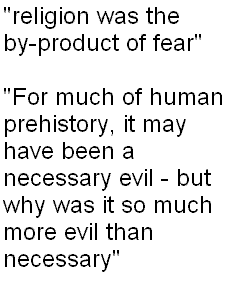
  • "religion was the by-product of fear - a reaction to a mysterious and often hostile universe. For much of human prehistory, it may have been a necessary evil - but why was it so much more evil than necessary". "I said evil - and I mean it, because fear leads to cruelty".
  • "obvious madmen, century after century, will proclaim that they - and they alone! - had received messages from God. If all the messages had agreed, they would have settled the matter. But of course they were wildly discordant - which never prevented self-styled messiahs from gathering hundreds - sometimes millions - of adherents".
  • "most of the humanity has always been insane, at least some of the time".
  • "There's never been anything, however absurd, that countless people weren't prepared to believe, often so passionately that they'd fight to the death rather than abandon their illusions. To me, that's a good operational definition of insanity."
  • "Do you believe in ghosts, Dim?" "Certainly not: but like every sensible man, I'm afraid of them."
Fact sheet.
3001 The Final Odyssey, novel, review
Author: Arthur C Clarke
Genre: Fantasy
First published: 1997
Rating: B

See also:
  1. "Space Odyssey series summary"
  2. "Influences" section of "Rescue Party"
  3. The ring habitat connected to earth with many spokes around equator that are space elevators that we see in first one third of this story also appears at the end of "The Fountains of Paradise". But there, we see it in about 4000 AD, & without details of its interior.
  4. "The City & the Stars", a much earlier novel, has a religious discourse about its middle that is essentially the same as that in the middle of this book.
  5. "Imperial Earth" is another Clarkian story that describes human life about the year 3000 AD. I personally find Imperial Earth's descriptions far more realistic.

Thursday, April 19, 2007

"History Lesson" (short story): Perils of concluding from little evidence

This really is two stories rather than one - a doomsday story, & an ET story. Both themes appear to be rather dear to Clarke's heart - going by number of stories he has written on these themes. Title comes from second story.

Story summary (spoiler).
Let's first talk about the second story - since title is named from this.

Assume an alien race from skies comes across a single photographic movie reel, without sound, from earth, & were to try reconstructing our life & culture? It is this speculation that essentially occupies the second half. E.g., is the orifice that often opens & closes in the lower half of the top round portion of these erect bipeds some kind of breathing device! That is a sample.

First story reminds me of the story of 108 tribes in the epic novel "Return of the Aryans" by B S Gidwani. Aryans obviously came after Clarke's story, but most of its stories are based on very old Indian literature & archaeological records. I don't really know the connection - except that two stories are nearly identical - in tone, theme, as well as presentation.

A tribe of humans is running from a disaster, crossing mountains on its move southwards - in search of new life. In Aryans, the tribe was running from famine & crossing Himalayas; in this story, tribe is running from advancing glacier, & crossing an unnamed mountain.

Now, lets fill in the blanks. For some reason, the Sun has cooled - without any other obvious effects. This has set Venus towards becoming friendly for intelligent life, & has doomed earth in a permanent ice cover.

First story is the about last days of humanity - glaciers are advancing from north & south - meeting mountains near tropics. While mountains the tribe is crossing are not named, you might be able to guess.

While earth is dying, Venus is in bloom. Thousands of years hence, Venus is dominated by an intelligent lifeform that is essentially reptilian. As they discover space travel, & come examining the third icy planet that could never have held life, they detect a faint radio signal. A kind of atomic powered beacon was secured up in a mountain cairn by the last tribe of humans as a sacred relic, along with a few other things - among them the photographic motion picture.

Second story is the attempt to interpret these relics & reconstruct the life as it was on earth - by Venusians.

Now the silly part. There is an echo of this Venus bloom in Clarke's more recent novel - "2010 Odyssey Two". Venus has cooled in former; Europa has heated up in later. In both cases, a life-friendly world has been created, & evolution moves at speeds way beyond anything witnessed on earthly evolution. There is another twist to Venus tale - in just 5000 years since bloom, not only are there conscious beings, but space farers comparable in competence to modern humans! In 2010, at least it took 20,000 years to reach the stage of stone age humans. Never mind that dumb earthly humans took something on the scale of billion years to achieve these feats!

See also.

  1. Earth turns into an icy wasteland at the end of "The Fountains of Paradise" also.
  2. An alien ship also visits a barren earth at the end of "The Ghost from the Grand Banks", & after much searching, is able to pick up a beacon that tells the story of intelligent life that once flourished here.
Collected in.
  1. "The Collected Stories of Arthur C Clarke"
  2. "Across the Sea of Stars"
Fact sheet.
History Lesson, short story, review
Author: Arthur C Clarke
Genre: Fantasy
First published: 1949
Rating: C
Listed in Contento's Top Ten Most Reprinted Stories.

Sunday, April 15, 2007

"2010 Odyssey Two" (novel): Generally a worthy sequel

This is the first of the three sequels to "2001 A Space Odyssey". Going by experience of his "Rendezvous with Rama" sequels, I avoided this one for quite a while. But this book is generally good.

There is a key change in continuing the narration from 2001: the mysterious alien artifact (TMA-2) is not on a satellite of Saturn, but is hanging in space between Jupiter & its innermost volcanic satellite Io. According to Clarke, this is to ensure this sequel is consistent with the original movie rather than original novel.

Story summary (spoiler).
It is convenient to look at this book as generally four stories - though they are far more tightly coupled than the stories of original 2001 were. Let me name them, for Clarke doesn't:

  1. International diplomacy & voyage to Jupiter
  2. Ghosts & gods
  3. Gods at Creation
  4. Europan (not European) gods
First story, international diplomacy & voyage to Jupiter, is the longest.

Americans are building a manned spaceship in earth orbit that will go to Jupiter, rendezvous with the spaceship Discovery left near the alien artifact in 2001 - to figure out what was known to that ship before contact was lost, & then again investigate the alien object for its secrets.

Russians are also building their own ship to investigate alien object. They missed out last time because Americans kept the secret to themselves for too long. And looks like they will end up finishing much faster than Americans.

Russians want American help to board Discovery, & to learn what is there in the data banks of that ship about aliens. Americans are not interested, till Russians come up with a trump card - Discovery is off orbit, & will fall into volcanic Io long before Americans can get there by their own efforts.

OK - so a Russian ship will go, with mostly Russian crew, but also 3 Americans - including the TMA expert, the man who programmed the robot (HAL 9000) that ran amok in 2001, & an engineer familiar with Discovery.

There is a silly part in voyage arrangements: Russians will travel normally, but Americans will travel in hibernation. Why? I guess Clarke just wanted to introduce yet another technology into narration; story would only have been cleaner without it.

Anyway, the Russian ship is approaching Jupiter, & American TMA expert is woken up. They are quite close to Jupiter, when the first twist comes.

Chinese have also been building a ship headed towards Jupiter, & they have technology far ahead of either Americans or Russians. This Chinese ship, Tsien, comes from behind, overtakes our friends, circles Jupiter, & lands on its icy moon Europa.

Our friends figure out why - to pick up water as propellant. Only the Chinese have other designs - they cause a diplomatic stir on earth by claiming Europa as Chinese territory. It seems, because of easy accessibility & easy availability of water, Europa could be an important refueling station for deep space exploration.

But Chinese have something larger than them up against them. Turns out, Europa has life - though primitive - in liquid seas under its icy surface. One such life form - half tree, half animal - manages to destroy Chinese ship & kill the crew. The man last to die sends a detailed report.

OK - tangent taken care off, our men head for the target. Dumbbell-shaped Discovery is boarded, fixed, taken to a safe orbit above Io, & the robotic HAL is fixed. And it has no clues to TMA-2 sitting close by in space.

Oh - TMA-2 has been renamed by now. Americans call it Big Brother; Russians by some other name I cannot recall.

All observations & probing of TMA proves futile, as in 2001. Our friends watch with infinite patience. Until TMA opens momentarily & lets out a mysterious lit object that can only be called a UFO.

Hence begins the tale of ghosts & gods, the second story. This is the worst part of the book, but thankfully it doesn't last long.

UFO is actually the American astronaut David lost in 2001 as he went into TMA, was taken for a ride by aliens, & turned into a pure energy being - a star child. We are told he still retains some human emotions and attachments, & is being held tightly on leash by aliens that have their own ends in mind.

When the Russian ship relays the UFO information to earth, someone decides to prepare with a nuclear bomb. Star child quickly detonates it in earth orbit, killing a few on surface of earth, but human losses could have been worse.

Then there are some adventures of star child - on earth to old haunts of David that is no longer David, on Europa exploring the life forms in its seas, inside Jupiter right to its core that is solid diamond, we are told. There are graphic descriptions of living animals on Europa, & also on Jupiter.

Then begins the tale of Creation, & of kick-starting intelligent life by gods - the third story. I was occasionally reminded of first story in 2001, & also of Encounter at Down, but generally this is a different story.

Our friends on board Russian ship (that has now been joined with older American ship through a kind of tube) are losing patience. All efforts to map TMA are failing. So they are planning to do something drastic - like detonate a powerful device on TMA surface, but are wary of reaction from TMA to such hostile acts. They are awaiting the launch window - some 20-25 days hence, when they can begin their trip back home; doing otherwise would require more fuel that they don't have. Plan is to do these hostile acts just before setting out for earth.

Now our friendly ghost makes contact with the TMA expert. He warns him to leave within 10 days (or is it 15? I forget).

Shipmates are divided on the ghost version. Though the TMA expert has impeccable credentials & is in good health, the captain wants something more substantive. Over the days, the crew gets more & more divided - some in believing camp, others not believing, others on the fence. Situation is not helped by reports arriving from earth - of the exploits of the ghost there.

Russian captain has another headache - even if she agrees to leave, there is not enough fuel. But there is the brilliant American engineer on board. Old ship Discovery still has fuel. They will rig it as a booster stage rocket, use some help from Jupiter's gravity, & with some luck, can get home safely even outside the launch window.

And then comes the next twist in tale. One fine day, the TMA simply vanishes. Now even the unconverted are converted, & plans for return are finalized.

Another twist is cooking elsewhere. Astronomers from earth have observed a new anomaly on Jupiter's surface - looks like the shadow of a new moon! Just as our friends are about to leave, they get a request as to whether they can take some pictures.

Starting the trip back home involves many twists - including convincing HAL of the changed schedule. It is during this trip that the black plague on the Jupiter's surface is noticed by our friends. And it is spreading fast. It seems, TMA that vanished went to Jupiter, & has been making copies of itself by sucking up local materials. And it is growing fast.

Enter a conversation between ghost & now all alone HAL. Ghost convinces HAL to stop talking to retreating Russian ship, & instead relay a message to earth as many times as it can. The message is very brief, & is from gods to mere earthlings: all planetary bodies around are yours, except Europa; leave that alone. Looks like the gods have designs on Europan lifeforms, but consider Jovian lifeforms discardable!

This is when the explosion happens. It turns out the gods that control TMA are about to turn Jupiter into another Sun - by increasing its density, & starting the fusion reaction! The plan is: its heat will warm nearby Europa, & help evolution of intelligent life there. It will also make other moons of Jupiter, new called Lucifer in its sunny avataar, more habitable. These other moons will be gods' gift to mankind.

Incidentally, during this cataclysmic event, HAL became another star child while the old ship Discovery was destroyed. So now there are two ghosts of earthly origin on the loose. Will likely help out in future sequels.

Now begins the final tale, the forth one. Of new intelligent beings just discovering their own gods. The year is no longer 2010. It is twenty thousand something. And the voices & opinions we hear are of the Europans. Some species there have just become conscious of the universe around, including their main sun Lucifer, & the little far sun. And of mysterious stars & lights moving around in the skies.

There is a little silly element that can be ignored. The beings described appear to be roughly at a stage of development that humans were some 30,000 years back, or perhaps slightly older ancestors. Anyway, the evolution on earth took some billion years to reach this stage from primitive animals; on Europa, this huge time has been compressed to just 20,000 years!

We are told humans have been probing Europan landing via unmanned probes for a long time, in spite of warning from gods. Every time their ship approaches, it explodes & is destroyed.

And yes, there is a TMA-3, on the surface of Europa, protecting its creatures from humans. Who will inherit the solar system - humans or Europans?

Enough hints of a sequel.

Fact sheet.
2010 Odyssey Two, novel, review
Author: Arthur C Clarke
Genre: Fantasy
First published: 1982
Rating: B
Hugo Award nominee in novel category in 1983

See also.
  1. "Space Odyssey series summary"
  2. "Influences" section of "Rescue Party"
  3. Another story by Clarke, from 1940s, titled "History Lesson" has a similar quick evolution on another world - even quicker than Europa.
  4. Humans create a sun out of Phobos, a moon of Mars, to terrafarm Mars in "The Sands of Mars".
  5. All Hugo Award stories.

Friday, April 13, 2007

"Encounter at Down" (short story): Another precursor to "2001 A Space Odyssey"

While there are differences, there can be no doubt this story, originally published as "Encounter in the Down", inspired the first story in "2001 A Space Odyssey". Note that second story in 2001 was inspired by "The Sentinel".

A much better version of this story that actually marries it with the first story in "2001 A Space Odyssey" appears in Clarke's "The Lost Worlds of 2001" under the title "First Encounter".

Key premise in the story is: neither earth nor humans nor other familiar life forms on earth are an evolutionary oddity; indistinguishable stuff must exist at hundreds of places in the galaxy.

Story summary (spoiler).
A (mother) spaceship that is a kind of aircraft carrier is doing a Galactic Survey in "the loosely packed stars at rim of the Milky Way". One of the actual survey crafts mothership contains is loose nearby (just 100 light years from mothership) with 3 occupants. Some background conversation tells us there is trouble in their home world, & the ship might be called back home in a hurry for more important use than purely scientific pursuits they are presently involved in.

OK - so the survey craft enters a star system, skips a gas giant while heading inwards, & comes upon a promising planet. The only problem is: this planet could have been their own home planet - so similar it is to their home world.

They land at a place that future locals will label Babylon, next to a good sized river. A robot is sent out to survey the land. From the description, this robot appears to me to be rather primitive for a race that considers 100 light years nearby. Robot is remotely controlled by one of the 3 occupants using a "keyboard".

After preliminaries, they notice a path through the grass. While path itself could be a favorite of any animal, this is a lead. They decide to cautiously follow it. And behold - what they see is a village of smart bipedals just like them, only leading a much simpler life! There is some amazement, but nothing really tricky; they already know of a 100 other worlds in galaxy where the pattern repeats.

Contact is made with one of the village hunters in a rather common sensical way, without frightening him, & in bits over several days. While not making contact, the ship surveys rest of the world, finds many other communities, all at the same relatively low level of technology development.

End is a parting from the local contact, & some rather high tech gifts to him (that will be lost in a generation). There is regret on the part of surveyors of not being able to help these beings leapfrog technologically in a few generations what they would themselves do in 100,000 years (or is it million, I forget). And there is wistful recognition, as the ship is taking off, on the part of local of being the only one of his kind that has met gods.

All through the story, I was not very sure whether the occupants of ship were humans, or primitives on the world they landed! There are only two clues - the place where they landed will in future be called Babylon, & the surveyors were operating thousands of light years from their home world in the general area of "the loosely packed stars at rim of the Milky Way". Draw your own conclusions.

There is a minor inconsistency that can be ignored; may be it was modern knowledge in the year 1953. Humans as we know appeared on earth about 35 thousand years back; at least 28,000 years back, they were still essentially cave dwellers. I am not a expert on primitive history, but villages must have appeared much later. Yet this story talks of either 100 thousand or million years (I don't recall correctly) to comparable level of development - may be the space farers are talking of their level of development! If evolutionary history of earth is any guide, our descendants a 100,000 years down will probably look as similar to us as we look to chimpanzees.

Still, it's not a bad read.

A note on various titles of this story.
This quote from "The Lost Worlds of 2001" provides some interesting information: 'An editor at Ballantine Books gave it the ingenious title "Expedition to Earth" when it was published in the book of that name, but I prefer "Encounter in the Dawn." However, when Harcourt, Brace and World brought out my own selection of favorites, The Nine Billion Names of God, it was mysteriously changed to "Encounter at Dawn."'

Fact sheet.
Encounter at Down, short story, review
Author: Arthur C Clarke
Genre: Fantasy
First published: 1953
Rating: B

The story appears in the following collections.

  1. "The Collected Stories of Arthur C Clarke"
  2. "Expedition to Earth"
  3. "Of Time and Stars"
  4. "Across the Sea of Stars"
  5. "More Than One Universe"

Thursday, April 12, 2007

ET (aliens) design in Arthur Clarke's stories

By now, I have read enough of Clarke's stories to know that ETs happen to be one of his favorite themes. He tends to be quite graphical about their description - so we can reasonably enumerate his favorite designs.

1. Pure energy beings. Going by the characteristics described, these are indistinguishable from Hindu concept of brahm (also called many other names in India in various sects & regions). The meeting of such ETs with humans tends to culminate in humans merger into this higher being through a process that is essentially the Hindu concept of moksha.

It is for this reason that I tag these stories as religious.

In contrast, I have read of at least 2 cases of energy beings in Asimov's stories, & they tend to be essentially secular:

  1. A short story where 2 energy beings meet & recollect their conscience to discover that they used to be a human male & a human female, respectively, eons back in time.
  2. In one or two of the 6-7 sequels to Foundation Trilogy, there are energy beings wandering around the galaxy angry at humans for having driven them from their ancient homes during human colonization that created Galactic Empire.
2. In "2010 Odyssey 2", there are life-forms at isolated places in the liquid water seas under the frozen surface of Europa, a satellite of Jupiter. One of their species - something that is neither plant nor animal - destroys Tsien, the Chinese ship landing there & claiming Europa as Chinese territory.

3. In Childhood's End, apart from energy beings that appear towards the end, there are what the humans call Overlords - bird like beings that look like the Christian traditional pictures of devil.

4. In The Songs of Distant Earth, there are large crab-like sea creatures under the seas of the non-earth watery world where action occurs. These are as smart as chimpanzees, or on the verge of being as smart - I do not recall the exact details. This story also describes some under sea & overland vegetation of alien origin.

5. In Rama II, their is a brief appearance towards the end of an eel-like alien that lives in liquid seas. It talks to human heroin via robotic interpreters. If I recall correctly, it talks via a kind of what appears to human observer as dance; I don't recall well this specific mode of alien talk.

6. In the three Rama sequels, there are octopus like creatures that
  1. can live in both water & on land.
  2. make a kind of metallic sound when moving on land.
  3. are expert at genetic engineering, & themselves come in at least 3 different sizes: normal, extra large capable of storing food for community, & microscopic for interactions with bacteria-like genetic machines used for such things as surgery.
  4. talk using a band of colors, some of them outside the spectrum visible to unaided human eye.
  5. keep a human couple & their child in their zoo - the way humans keep zoo animals.
7. In the 3 Rama sequels, there are 4-part synergistic beings:
  1. Sponge- or cotton-like that are essentially pure mind, & are physically defenseless.
  2. These sponges produce eggs that humans call "mama melons".
  3. From "mama melons" hatch short-lived quick-moving somewhat cat-like & smart animals that do most interactions with sponges. They die by going inside sponge, which absorbs their tissue.
  4. Big birdlike animals capable of flight, but not very smart. They eat "mama melons". In return, they provide physical security to sponges & their quick-moving progeny; hence synergistic with them.

Wednesday, April 11, 2007

"The Star" (short story): Interesting, if a bit religious

While I don't recall a Clarke's remark to the effect, the conclusion is unmistakable: this story as well as the novel "The Songs of Distant Earth" are essentially variants of Clarke's first published story - "Rescue Party".

All three share an identical doomsday scenario: the star shining on the home of an evolved life form explodes killing all life & planets. In Songs & Rescue Party, it is the Sun shining on earth that explodes; in this story, it is the sun shining on an alien world 3000 light years from earth that exploded 6000 years back.

Full text of this story is available online (link via BestScienceFictionStories), as also an MP3 version (link via SF Signal & Free SF Reader). I haven't seen either of these online version, but quick skimming of text version suggests it's the text I read.

Story summary (spoiler).
Humans have figured out a way of traveling really great distances - at least 3000 light years in less than a human life time. A survey ship comes upon this remnant of a star - a tiny version of its earlier self, surrounded by several concentric shells of dust that are still expanding & are what remains of its outer surface & planets after explosion.

But one outer planet about the distance of Pluto from our Sun survives - barely. Much of its outer ice covering is gone, but a rocky surface remains. That is where our surveyors land. And they find a vast building, & also some remnants of radio signals in rocks.

The building is a huge vault. Apparently, there were intelligent space travelers living on one of the inner worlds that no longer existed, but they had not yet mastered interstellar travel. They had taken extreme pains to stock the vault with the best of their culture & artifacts.

And they had taken a lot of pain in explaining this in a variety of ways to any intelligent aliens that might in future come upon what remained of their world. They did not want all signs of their existence wiped out. Now the humans are burdened & honored with paying homage to them & preserving their relics.

The story is told through a Jesuit priest on board the surveyor - in somewhat religious undertones.

Personally, I found both Songs & Rescue Party better stories. But this is not a bad story.

Collected in.

  1. "The Collected Stories of Arthur C Clarke"
  2. "More Than One Universe"
  3. David Hartwell & Kathryn Cramer (Ed)'s "The Ascent of Wonder: The Evolution of Hard SF".
See also.
  1. This story is unrelated to H G Wells' "The Star", which inspired Clarke's "The Hammer of God".
  2. "Improving the Neighborhood" is a much shorter variant of this - but earth dies here, & aliens mull over the kind of sentients we were.
  3. All stories with religion as a theme.
External links.
  1. Jeff Vehige discusses this story from a Christian religious perspective. I am not familiar with Christianity, & could neither relate to those nuances, nor considered them important. But others might care.
Fact sheet.
The Star, short story, review
Author: Arthur C Clarke
First published: 1955
Rating: B
Listed in Contento's Top Ten Most Reprinted Stories.